Showing posts with label Africa. Show all posts

Tuesday, January 15, 2013

Out of Office

My American family came to visit so I took the rest of my vacation days and haven't been online much  at all lately. I'll be back in Senegal (all too) soon and will be post pictures and updates as regularly as the internet connection allows. 

In the mean time here is a photo of the ocean in Praia. It's very much a postcard-come-to-life-type-place, lots of warm waves and tropical fruit. Hope your year is also off to a beautiful start! 

Praia, Cape Verde

Monday, July 9, 2012

World Map Project

My neighbors in Salémata and I have been working on painting World Map Murals in each of our villages and last month it was Salémata's turn. After chatting with the Primary School Director and choosing a place to put the mural I spent an entire day setting things up and gridding the map outline. (Gridding is where you have an image drawn on a small grid and then you draw a big grid and copy the image over square by square.) I had a very handy grid plan printed out but it still took hours and hours to lay out all the lines and copy everything over.


The next day Jubal and Jackie came to help with the painting part, which was great. I took pictures every few minutes to show how the mural progressed from start to finish. Here's a link to the album; if you play it as a slideshow on the fastest setting it has a nice flipbook-ish feel to it, I'm really happy about that.

Salemata World Map Montage 2012

Thanks to the wonderful people who send us care packages we had some decent paintbrushes, but prying the paint cans open took quite a bit of effort (no screwdrivers on hand, unfortunately) and the mixing of some of the colors was challenging. The blues and reds came out bright and vivid, but the oranges and purples came out a little flat and drab. (Sorry, Canada.)


The painting was definitely more fun than the gridding, both because it was colorful and also because I had good company all day long. We even had music (faintly) playing in the background, thanks to my ipod touch.


We also had an audience, which got to be somewhat annoying at times. I made a rule that only a few kids could come in at a time and they had to leave if they touched wet paint, were rude to each other, or made too much noise. For the most part the kids were endearingly enthusiastic and pretty respectful about the precarious jars of paint, smelly old wine bottles filled with paint thinner, and the grid papers and country name lists scattered about. The teachers and Director were very impressed (it was funny how surprised they were with how well it turned out) and pleased with the mural; they've already asked if we can come back and paint a map of Senegal in one of the other classrooms.

It was great to work on a team project, and also really nice to do something tangible, straightforward and finite. This month I'm planning on going back in to draw outlines around countries, double-check the border we made between Sudan and South Sudan, and write "La Carte du Monde" along the bottom with our fancy golden paint pen, and then it will really be finished.

(I'm just awkwardly pretending to have a chair here.)


Sunday, June 3, 2012

Mid-Service

I was just up in Dakar for my mid-service medical appointments. About a year into service PCVs are supposed to come up to Med to have a check up with a doctor, a cleaning and x-rays at the dentist, and a tuberculosis test. Depending on what the PCV needs they'll also do a Pap smear, HIV and STI tests, MIF (stool sample) kit analysis, and tests for various parasite problems, such as schistosomiasis, a sort of snail-worm infection. Schisto, as we like to call it, is a neglected tropical disease (NTDs; they're horrible but fascinating) and is very common in my region. 


My check-up was pretty brief and boring; other than strep throat, switching off Mephaquin, a few relatively minor bouts of diarrhea and vomiting, I haven't really had any significant medical problems so far. (Knock on wood.) My schisto results haven't come back yet, but I don't have any cavities or tooth-problems (yay!) and my TB-exposure test was as negative as they come. The dental cleaning is a little odd, mostly because the dentist (a cheerful older Moroccan man) doesn't do things like give you a free travel-sized tube of toothpaste or provide a lead apron during x-rays. In fact, he takes the x-rays while standing next to you, sometimes whole holding the little square of film in place against your teeth with his own hand. He also develops the x-ray films right there, rinsing the chemicals off right into his little lab sink. It's how I imagine American dentists did in the olden days when it was totally okay to use fluoroscopes for fun and have women hand-number clock faces with radium paint.

In any case, it was interesting and good to get all checked out. And totally bizarre that I'm already more than halfway through my service. How is it June 2012 already?


Friday, June 1, 2012

"Adama"

My American name is LaRocha ("la-rock-a"), but my Senegalese name is Adama. I have a number of tokorabe (people with my same name) around Salémata. I've gotten used to it, more or less, but for several months it was profoundly weird. 

It took me awhile to really identify as "Adama," and once I actually started to feel like it was my name I couldn't really get my head around how a bunch of other people also had my name. That has never happened to me before. Ever. In my entire life. It's funny, I spent a significant part of my childhood wishing that I had a name that other people had (specifically so that I could have a personalized toothbrush and name stickers) and then when I finally did it was oddly disconcerting. 

Adama and Friends
I've gotten used to it, though, and have come to appreciate some of the perks of having a normal, phonetic, immediately understood name. Greetings and mundane daily interactions are smoother and less complicated, and when people read my name off a list they don't hesitate and look around, blinking and uncomfortable, for a few seconds before attempting to say it aloud. They laugh, sometimes, amused that such an obvious foreigner would go by such a Senegalese name, but it's always friendly and often leads to questions about my family same (Souaré, "soo-are-ay") and where I live and if my family is in peace. 


Also, sometimes people are extra nice to their tokora, which is arbitrary but pleasant, and I'm not one to argue if the peanut butter lady or the bean sandwich lady wants to give me an extra spoonful just because I'm her tokora.

Les Parfums de Sénégal

Not long after I came to Senegal I was in a car with a few other PCVs, and we got to talking about what scents a Senegal-themed scented candle set would include. (I think it was April's idea.) In any case, I still think about that when I catch whiffs of  Senegal-specific odors. As best I can recall, here are some of the odors we identified as being the iconic smells of PCV life in Senegal: 
  • Café Touba: at pretty much every bean sandwich lady's stand in the whole country you can buy hot, sugary little cups of Café Touba to go with your breakfast. (Many PCVs love it; I am not so much a fan.) It smells over-boiled and slightly peppery, like cloves and leaves and instant coffee.
  • Fish Market: in most markets there's a section devoted to selling all kinds of fish - big, small, fresh, dried, semi-spoiled - and it always reeks of fish guts turning rancid under the most powerful heat lamp in the world. 
  • Trash Fire: one of the least-lovely smells to wake up to. 
  • Tea Time: the singed-sugar smell that comes from cooking up the scalding, hyper-sweet ataaya tea that many Senegalese like to drink int eh afternoons (and mornings... and evenings...) 
  • Dust: it's subtle, just a light, hot, dry smell, but it's also everywhere, especially on transport. It cakes up on clothes and in sinuses and gets way down into the seams and cracks of everything, from books to keyboards to skin and hair. 
  • Mango: fresh, sweet, sun-warmed and lovely, mangoes right from the tree are one of the few silver linings to hot season. 
Other suggestions were Overpowering Body Odor (particularly while crammed in a crowded bus or a station wagon with nine other people), Sewage Puddles (a rainy season fixture in all cities), and Adji (the bullion packets that are the base flavoring for nearly all Senegalese dishes we eat on a regular basis).

Maybe the candle set would look like this. 
Sadly, for me (and the other people in the room with me right now) Trash Fire would have to be the smell that I most strongly associate with living here. While away on vacation I stepped out of the car after being picked up from the airport and the first things I thought was "Oh wow, it smells so nice here." I've heard that repeated - unprompted and almost verbatim - from several other volunteers.

There are many other smells that spring to mind when I think of my life here in Senegal, many of them quite pleasant - babies all freshly washed and lathered in warm, nutty-smelling shea butter; sweet, floral "chourie" incense paste; the fresh-baked bread smell of tapalpa village baguettes. But really, Trash Fire tends to overwhelm them all. 

Thursday, May 17, 2012

2012 Bassari Initiations

Last weekend I (along with half my village, a dozen other PCVs, a few European tourists, a handful of Canadians) went to the Bassari village of Ethiolo ("Etch-il-o") to see the annual coming-of-age initiation ceremonies for young Bassari men in the area. 
PCV Tatiana, AKA Taki Bendia, our gracious hostess
We started by hanging out with Tatiana's host family, greeting people, eating fried dough beignets and watching things get started. I don't have a super comprehensive understanding of all the aspects of the ceremonies, but one of the first things that happens is that people from each initiant's family bring out live roosters, slaughter them, and then hang them all from a tree. (The men in the photo below left are taking the roosters down, to pluck and butcher them.) The people running everything fire off blank shots to signal that the initiants have started coming down from the trees, dancing in lines that wind slowly though the crowd before heading off to a hill for the battle portion of the initiations. 

The battles take place a little ways off form the village, out of the sight of women; we heard that this is because it's embarrassing when a man loses a fight (and every fight, even the highly ritualized initiation fights, has to have a loser) and they'd rather not have the women knowing who all the losers are. In any case, while the guys all went off to the battles we passed the time looking at the jewelry vendors' wares until Marie Christine (our wonderful housekeeper at the Regional House) invited the ladies over for snack time. The snack turned out to be chunks of fresh bread with a sautéed onion and green pepper dipping sauce, and it was pretty fantastic. 


When the battles were over and then masked Bassari men and the younger initiants, lead by a man wearing a heavy-looking wooden mask, came streaming back up the hill. Many of the younger kids fled in terror (they are pretty intimidating up close) and everyone clambered up onto rocks and logs to get a better look. 


 After the frenzy of the arrival of the masks we retired back to Tatiana's family's corner to drink water and sample the Bassari palm wine, honey wine, and millet beer. (The Bassari are mostly somewhat Catholicized traditional animists, so there's no religious prohibition of alcohol in Bassari areas.) The honey wine is pretty good, as is the millet beer, but I'm not really a fan of palm wine and none of it is particularly easy on the stomach (especially if you're getting over some sort of stomach bug, which I was) so I didn't drink much.


 We ate a big chunk of peanut butter candy (above left) made from cornmeal, peanut butter, and sugar, and Tatiana's family cooked us a wonderful lunch of chicken and cabbage sauce over rice. Over the course of the day I ran into pretty much everyone I know in Salémata, including my friend's little brother (above right)who really wanted a photo of himself with the masked men. He's a good kid and his family hadn't come to watch the initiations, so we invited him to have lunch with us and he showed us the random things that the tourists had given him -- specifically, a pair of nice ladies' dress slacks and a navy blue skort.


This last photo is of an initiant with his family, standing on a mat with the gifts that have been offered to him to commemorate his achievement. He's standing in a tub of rice and onions, and there's a sack of rice, some corn, millet, and other foods on the mat as well. He's looking over at his family members who are in the process of slaughtering a goat in his honor. I lost count of the number of roasting goat (and sheep, even a cow) heads I saw over the course of the day. Most people don't eat meat or fish on a daily basis, but they really pull out all the stops for holidays and special celebrations.


Transport

Transport is usually the worst and most unpleasant part of living in Senegal. Unless you're well-to-do and have your own car and driver the "public" transportation system is made up of a chaotic, ramshackle network of privately owned beat-up buses, rusty jumbo-vans, smaller-but-equally-rusty vans and mini-vans, pick-up trucks, horse/donkey-drawn charette carts, and safari cars. It's expensive and unpredictable (cars leave the garage as they fill up, so you wait three minutes or nine hours), the guys in charge of cutting tickets are usually loud, aggressive, and will often stretch the truth to pressure foreigners into buying tickets, and the baggage guys frequently try to extravagantly overcharge people (last time I went from Tamba the guy tried to charge 2 000 FCFA for a bag that should cost 500 FCFA) but they also tend to relent pretty quickly when you tell that that you've been here before and you know the price.

A typical transport receipt 
Each city has a "garage," which is just a big parking lot where cars and buses park and wait for passengers. The garages in Dakar and the other big cities are sprawling and hectic, filled with vendors and ladies selling ceeb u jen, but the mayhem is somewhat organized. There are garage managers, and the guys in charge of selling tickets who make sure that cars get passengers and leave in the proper order. In the smaller cities, like Kédougou the garages are smaller, slower-paced, and more manageable. In a mid-sized village like Salémata the "garage" is just a bench in front of a sandwich shack, with a guy who sits around, making tea and writing out little ticket stubs. (I happen to glue all my travel tickets, baggage stubs and other paper miscellany into my journal, so at this point I have a comprehensive catalog of the kinds of hand-written receipts that there are in Senegal.

We don't get many nice transport cars out in Salémata on account of our road being rough, dusty, unpaved, somewhat washed out in a few places, and 80 kilometers (about 50 miles) long. It gets worse once the rainy season starts; the road gets muddy, occasionally floods completely by the bigger bridges, and we don't get very many cars at all.

A sept-place and a green van in the Salémata Garage
The nicest vehicle in the Salemata Garage that morning

I got lucky with this car because it had decent-looking tires, the engine sounded ok, the uplostery was still pretty much intact, and it had been painted pretty recently. The interior (below on the left) looked pretty nice. The photo below in the right is of the Salémata garage and main street, where the weekly lumo market happens on Tuesdays. There weren't many people around this morning (which is partly why I felt comfortable taking photos), just people stopping on to buy bread and boutique owners sweeping garbage into little piles and lighting little trash fires. 


I only had to wait for about an hour and a half, which really isn't too bad. The car also didn't stop that many times to pick people up along the way, so it never filled up to the point of being ridiculously over-capacity. They also let me hop out right in front of the Peace Corps house (conveniently right on the road in from Salémata) and that made things easier, too.

Saturday, April 28, 2012

Highly Fashionable


I wear things here that I just wouldn't wear in America, (unless I was at summer camp, where I once wore a vividly teal full-body rain suit with yellow cuffs) especially when I'm in village. This is a country where an all-fuchsia outfit with sparkly gold trim is considered pretty but not at all out of the ordinary, and I've gotten used to it. A few months ago I was walking to the water pump with my purple bucket, and noticed that I was wearing pink flip-flops, bright red pants with yellow squiggles, a bright green t-shirt, purple glasses and a tan hat. At least my glasses matched my bucket, I guess. 

So when I came in to the Regional House, (where there are other Americans) looked down at myself, and all of a sudden realized I was pretty much dressed like a giant crayon, right down to the green flip-flops. I couldn't find my green hat, or I would have put that on, too. 

Crayola Green

Friday, April 27, 2012

World Malaria Day

So. Malaria. Basically, a person gets malaria from the bite of a mosquito infected with Plasmodium parasites. The parasites get into the bloodstream, mess up the red blood cells, and start making the person all feverish and then really, really sick. If another uninfected mosquito bites that sick person then that mosquito becomes infected and can pass on  Plasmodium parasites to the next person it bites. 
Image thanks to iayork.com
Only female Anopheles mosquitoes can infect humans with the Plasmodium parasites that cause malaria. (Italics because it's the Latin name,not because I'm trying to be extra emphatic.) There are different strains of Plasmodium parasites, some more dangerous than others, and here in Senegal we have mostly Plasmodium falciparum, which is pretty much the worst kind. You can avoid getting malaria by taking prophylactic medications like doxycycline, mephloquine (Lariam), or atovaquone (Malarone). If, for whatever reason, these medications aren't an option you can reduce your chances of getting malaria by using insect repellent, sleeping under a bed net, and getting rid of standing water and other mosquito breeding grounds. 

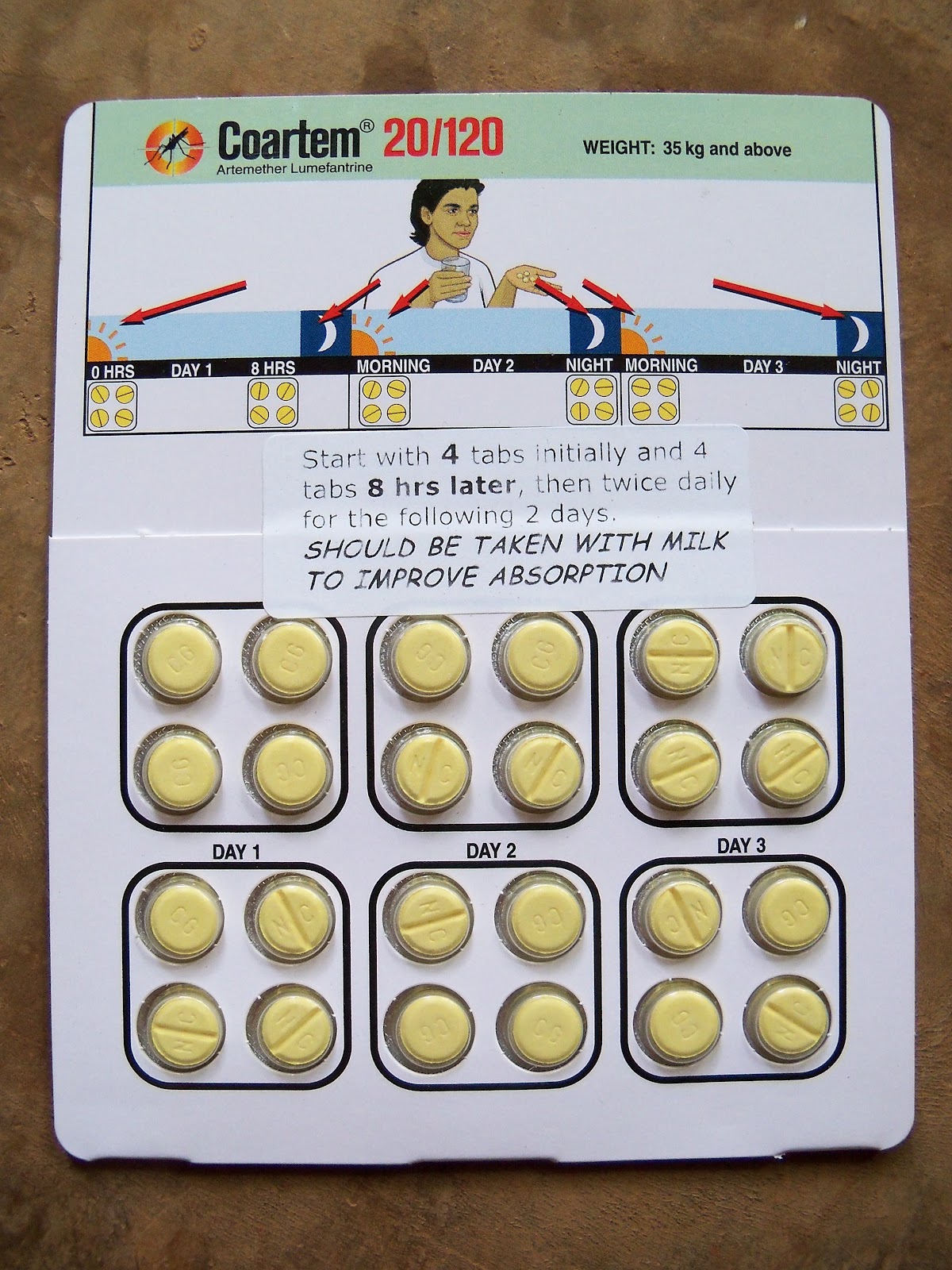
If you do get malaria there are effective, affordable treatments available, even in places with  chloroquine-resistant malaria, like Senegal. Our Health Center is usually well-stocked with government- and NGO-subsidized Malaria Rapid Tests and Coartem medication packs, especially during rainy season, when most malaria cases happen. Here are photos of the Coartem for adults that Peace Corps gave me (but which I will hopefully never need because I'm good about taking my prophylaxis) and also of a pack of Coartem for children that's available at the Health Center. 


This past Wednesday was World Malaria Day, and people all around the world did activities and held events to acknowledge the damage caused by malaria and to raise awareness of how to prevent malaria. In Salémata, my village, Wednesday was also when our Health Center has its monthly vaccination and growth monitoring activities. We didn't do anything huge because it was already a pretty busy day, but we did have an informal causerie discussion with the mothers who had brought their babies to be weighed and vaccinated and who were just hanging out, waiting for the nurse to call them up. Adama Dioulde Diallo, one of the women who does community outreach  Salémata, used  my little set of info cards to give little presentations on how to properly use and care for Long-Lasting Insecticide-Treated Nets (LLINs) and we talked about setting up a bednet care-and-repair activity sometime soon.  
Adama Dioulde Diallo

If you like maps and are interested in learning a little more about malaria, please check out the CDC's fantastic Interactive Malaria Map. It's neat. 


Thursday, April 26, 2012

Adios Amigos

When it comes to living in Senegal there are hard parts (e.g. the heat, the awful transport cars, the skinny skinny babies, the pockets of abject poverty, the unwanted marriage propositions, the complete lack of dental care...), there are nice parts (e.g. the wonderful host families, the chubby babies who try to steal my glasses, the total strangers who take us in and feed us just because we're there, the tailor who refuses to accept payment for fixing the holes in my pants, the beautiful waterfalls, overwhelmingly delicious holiday dinners, everyone's Halloween costumes, N'ice Cream...). And then there are sad parts (e.g. the good-byes).

The new stage of Health PCTs (Peace Corps Trainees) are almost done with PST (Pre-Service Training), which means that the last stage of Health Volunteers has gone up to Dakar and COS-ed (Close-of-Service) and we miss them already. Especially these ones:

Frosting with Meera
Meera taught me everything I know about tailors in Kedougou, making pancakes at the Regional House and dancing like an old Bedik lady. We are an amazing food-making team and breakfast will not be the same without her. I took most of the clothes she left behind and pretty much plan on dressing up like her for the rest of my service. I'm currently wearing her pants. 

Laterite Spray-Tanning with Leah
One time Leah let me come to her doctor's appointment to get an x-ray looked at, just because I had nothing better to do that day and afterwards the doctor bought us both ice cream, which was awesome. Another time I completely covered her kitchen basket with pictures of babies, because she totally has Baby Fever. One of the most unexpectedly best times I've had in Senegal was on a bike trip when Kate's tire sheared open and we all spent the afternoon slogging through ridiculous mud fields and pushing our bikes across rivers. It could have been completely miserable, but because Leah was there it was hilarious and fun.

Hamburgaling with Eric
Ohhhh Eric! Whether we were taking imaginary vacations, making Joseph into a real person, watching tonic magically freeze, or trying to discretely mix Fant-angria in the back seat of a sept-place, we always had the best times and the funniest nonsense jokes. When I got really sick and completely fainted while coming out of the latrine Eric went into EMT mode, put me in a recovery position, cleaned up my scrapes, set up a straw system so that I didn't have to sit up to drink ORS, and pointed out that at least I fainted coming out of the latrine or things could have been a lot worse dignity-wise.  Fun Fact: Eric coined the term "John Boehner Laterite Road Tan."

On a side note, I can't help noticing that the John Boehner Laterite Road Tan makes my teeth look so pearly white. And also that I maybe should wear a different tank top sometimes. 

Wednesday, March 7, 2012

This Old Hut

It's hut renovation and construction season here in Salémata, and people are building huts all over the place. These new huts are near the Health Center and the roof thatch is already all stacked up and ready to go.


Mariama, one of my host mothers, is having a new hut built. It's square instead of round, which I think is fancy.
Hut in Progress
It's also time to start mending or replacing roof thatch, before it gets ungodly hot or too close to the rainy season. People go out and gather tall grass, bundle it up, let it dry out in the sun, and then tear off the old roof and re-thatch the whole thing. My host family says that my roof (which I'm pretty sure is mostly made of spiders at this point) is due for some repairs, possibly a replacement, which will be interesting. (This photo is of one of our neighbor's huts, I'm not actually sure who usually sleeps in it.)

Partially Un-Thatched
There's a nice hut getting torn down and rebuilt pretty close to my compound. They're about halfway done right now and I really like how it's basically a cross section. Every time I walk by I think "Anatomy of a Hut."


Some people choose to get a little more creative with their renovations:
The Pink Hut of Salemata
(I think the guys who do the painting for the castle got to use some of the leftover paint.)

Thursday, December 22, 2011

Sunrise

Last Saturday I got up at dawn to bike from Salémata  into Kédougou, and this was the sunrise that morning. It was cold. I wore my fleece for the first hour, and my ears ached from the chill, but it was still a pretty lovely ride. 

Monday, December 12, 2011

Plant Life

What is this plant? I saw it in Tamba and I've asked around a little bit. I have no idea, but it looks like some sort of edible citrus-type-thing.


These are my favorite tall-grass-type-plants (obviously I'm not an Ag volunteer) because they remind me of something out of Dr. Seuss. The grow all around the now-dried-up cornfield behind my house.


This is a big baobab near my compound - I'm pretty sure that big branch blew off one really windy night not long ago. They call baobab bohe "bow-hey" in Pular and pain-des-singes "monkey's-bread" in French. Once the big, fuzzy, Christmas-ornament-like pods dry out people collect them, break them open, pound and sift the dry fruit pulp, and use the sweet, tangy powder to enrich porridges or make a thick, sweet nectar that people like to mix with bissap hibiscus juice on special occasions. 


Tuesday, November 29, 2011

Home Away From Home

When I walk from my hut to get water (or go to the boutique, or buy a bean sandwich) I usually walk through this field, next to the Sofidetex shed where they store cotton-related stuff, and, especially with the palm tree, the view always strikes me as being very Northern California-esque, like the foothills around Mount Hamilton.