Showing posts with label hot hot hot. Show all posts

Saturday, September 8, 2012

Endless Trash

Waste disposal is a huge problem here; trash cans are often non-existent and littering is completely normal. Sewage, garbage, recyclables, food scraps - too often they wind up strewn about on the ground, waiting to be swept up and burned or washed away by rain or just left there forever.

Trash on a beach in St Louis

A typical debris-filled drainage ditch in Dakar
In the U.S. people produce a truly astounding amount of garbage on any given day, but for the most part it's quickly whisked off, to landfills or barges or processing centers or treatment plants, and we don't have to look at it. In Senegal everyone has to look at it. Pretty much all the time.

When I first arrived here the sheer volume of trash was one of the most striking things about the city-scape. When I travel around the country I still get hung up on how much garbage I see by the roadside, on the outskirts of towns, and just generally strewn around on the ground.

One of Dakar's many refuse-strewn lots
Batteries, old clothes, corn cobs, broken shoes, cardboard boxes, empty bottles, old notebooks, used-up pens, animal bones, mango peels, burnt-out light bulbs, candy wrappers, an ocean of plastic bags; anything you could use or grow or buy and then throw away is piled in the great swaths of refuse fanning out around the cities, towns and villages.

A village garbage pile in a field

Litter in a village creek bed

Rubble in a village ravine
People nonchalantly toss wrappers out car windows and drop soda cans right in the gutter without a second glance. For someone coming from a part of the world where littering is not only illegal but considered morally reprehensible, this is profoundly unsettling. It's awkward to watch. When there isn't a wastebasket handy (which is almost always) and no one to come by and empty a wastebasket anyway it's hard to argue with. It's a complicated problem and is difficult to change, but there are many people, PCVs and Senegalese, trying to do just that, with Sanitation Committees and public awareness campaigns and designated trash collection and burning areas.

Trash on a village path
At the end of the day all of this really, really makes a person appreciate the often unrecognized value of well-enforced anti-dumping laws, all that chiding about putting things in the proper bin, and access to an efficient garbage collection service.

Thursday, August 16, 2012

Map of Senegal

After our World Map Mural went so well the director of the Primary School asked me to do another mural, an outdoor one, to beautify the school. Actually, he didn't really ask so much as declared, in a loud, jovial way, that I must come back and do another mural, as soon as possible. I agreed, got my paints together, gridded a little map of Senegal I had lying around, and got to work. 


I got this far in one afternoon, but the holes in the wall were a stumbling block. Fortunately, there were some Bassari guys doing a construction project at the school, putting a cement floor in a new classroom, and it was pretty easy to convince them to come put some extra cement in the wall. 


After the cement dried I used bits of leftover paint to smooth things over (and because it's fun to smush colors around) and then came back the next day to paint a background for the school title. I also touched up the places where some little kids had scribbled with charcoal and left dusty little hand-prints in the still-tacky paint. Ugh. Kids.


Most of the kids were pretty cute and extremely respectful, actually. They'd sit near me, asking questions, bickering with each other, or reading the names of each department aloud. There was one kid who greeted me and then sat in the shade, making little things out bits of trash and singing made-up songs using the text from the wrappers and tins he was playing with. (He was my favorite.) The morning after that I came back again to add text, a fancy ribbon, and general finishing touches. 


The director requested that I write "Discipline - Work - Success" across the bottom, and I obliged, even though it isn't the slogan I would have chosen for an elementary school. I might have gone with something like "Friendship! Learning! Dreams and Rainbows!" or something similarly American, but he's the director and he seems to care about improving the school. I also misspelled "Discipline" but realized it only a couple hours after I'd finished up, while jogging by to admire my own handiwork, so I'm pretty sure corrected it before anyone noticed. Success!

Spell-Checked.

Saturday, July 21, 2012

Lunch in my Hut

A few weeks ago I was working over at the Health Center, things went long, and I came home late for lunch. This happens occasionally, and when it does whoever cooked lunch (my host moms take turns, work-sharing is one of the big perks of the polygamous lifestyle) saves me a bowl of rice with peanut sauce (nine out of ten times lunch is rice with peanut sauce) and I eat it in my hut.
I always eat with a spoon. Most people on my compound eat with their right hands, but my host father, a few of the older girls, a few of the older boys, and I all eat with spoons. They switch back and forth sometimes but I've been told that "Americans eat with spoons, and you're American. Also you don't know how." Which is true, I've tried in other villages; it's a terrible mess, the sauce is too hot on my fingers and it feels awkward. So, my lunch comes in a bowl, with a spoon for me. Inside is more than enough rice and a smaller bowl of sauce.


According to good Senegalese mealtime manners, I portion out some of the rice, so as not to "ruin" it by getting sauce all over it, fluff up the remaining rice, swirl the sauce around, and pour it, all with my right hand only. In Senegal, as in many parts of the world, the left hand is the toilet hand  and is therefore considered unclean. (People here use water instead of toilet paper, kind of like a do-it-yourself-bidet, but that's another post for another time.)


In any case, after I pour the sauce I eat the rice, eating from the part of the bowl that's directly in front of me and only mixing one bite at a time. I add rice and sauce if I finish my first portion and am still hungry. Pretty often I've already been fed at the Health Center, but my host moms are good cooks and it's nice of them to save me food, so I eat enough to be polite, even if I'm not very hungry.


After I'm done I put the sauce bowl in the bigger bowl and cover it with the lid and the nice sauce-free extra rice and bring it back to one of the two kitchen huts. Sometimes one of the older kids will eat the leftovers as an afternoon snack, and sometimes they'll feed it to one of the little kids as a pre-dinner snack.


And that's lunch in my hut.

Thursday, May 17, 2012

Demystification & Installation

During Pre-Service Training (PST) the Peace Corps Trainees (PCTs) get to go on a Volunteer Visit (VV) to see the villages where they'll be living and serving for two years. Every region (and even every site) is very different, and it's really good to get a basic idea of what it's like there. Is there a water spigot or will you be hauling water from a well across town? Are there mango trees or just thorn bushes? Does the village have a baker and boutiques or nothing at all in the way of places to buy snacks? The PCT gets to sort of shadow a current Peace Corps Volunteer (PCV) for a few days, and hopefully that helps demystify the whole life-in-village thing a little bit.

I took PCT Katie O. out to her village, and it went really, really well. She'll be the first volunteer ever to serve in her village, and people seemed genuinely excited and really, really, really nice. They fed us wonderful food, (fonio! chicken and sauce!) showed us around town, and were just generally really hospitable. There's a baker, some boutiques, a bean sandwich lady, lovely community gardens, a couple good hand-pump forages for water, and her hut and latrine were mostly finished.

Katie (the PCT) and myself
Getting ready to bike the rest of the way in 
Yesterday, accompanied by Mamadou Diaw (basically the boss for Health PCVs in Senegal), we went back to install Katie in her village. The traditional village chief gave a welcome speech; the head nurse from the Health Post gave a welcome speech; Mamadou gave a speech about Peace Corps, likening a PCV to a knife, which cannot cut by itself, urging the community to be patient with language, and thanking them for their overwhelming hospitality. Her hut and latrine were all ready to go, her family had built her a little fenced in garden, and the entire community had prepared a huge arrival party in her honor. Dioula ("joo-la"), her sister and village namesake, had had matching complet outfits made, they gave her earrings and a necklace, the school children had prepared a song-and-dance in her honor, and the griot musicians and the older women all sang and danced -- it was an amazing party, above and beyond what most villages put together, and it was completely heartwarming. 
Katie (the PCV!) and her tokora
I tried to stay in the background, taking photos and greeting as many people as possible, playing the photographer and mostly taking pictures with her camera. After the first round of singing and dancing there was a parade through the village, which was funny because there was next to no one to to see the parade, since everyone was in the parade, but it was fun. 

Parade through the village of Dakateli
After all that the party continued, but they pulled us aside to feed us lunch. We were presented with the biggest bowl of rice I've ever seen, and a small vat of rich, wonderful sauce with two entire chickens chopped up in it. It was all very reassuring -- when a community invests this much time, effort, energy in making the PCV feel welcome, included, and well cared for it bodes well for everyone. Not that it isn't exhausting and overwhelming or that village life won't be incredibly challenging in many ways, but it's a very good start.

Dancing and singing for the new arrival


Friday, April 27, 2012

World Malaria Day

So. Malaria. Basically, a person gets malaria from the bite of a mosquito infected with Plasmodium parasites. The parasites get into the bloodstream, mess up the red blood cells, and start making the person all feverish and then really, really sick. If another uninfected mosquito bites that sick person then that mosquito becomes infected and can pass on  Plasmodium parasites to the next person it bites. 
Image thanks to iayork.com
Only female Anopheles mosquitoes can infect humans with the Plasmodium parasites that cause malaria. (Italics because it's the Latin name,not because I'm trying to be extra emphatic.) There are different strains of Plasmodium parasites, some more dangerous than others, and here in Senegal we have mostly Plasmodium falciparum, which is pretty much the worst kind. You can avoid getting malaria by taking prophylactic medications like doxycycline, mephloquine (Lariam), or atovaquone (Malarone). If, for whatever reason, these medications aren't an option you can reduce your chances of getting malaria by using insect repellent, sleeping under a bed net, and getting rid of standing water and other mosquito breeding grounds. 

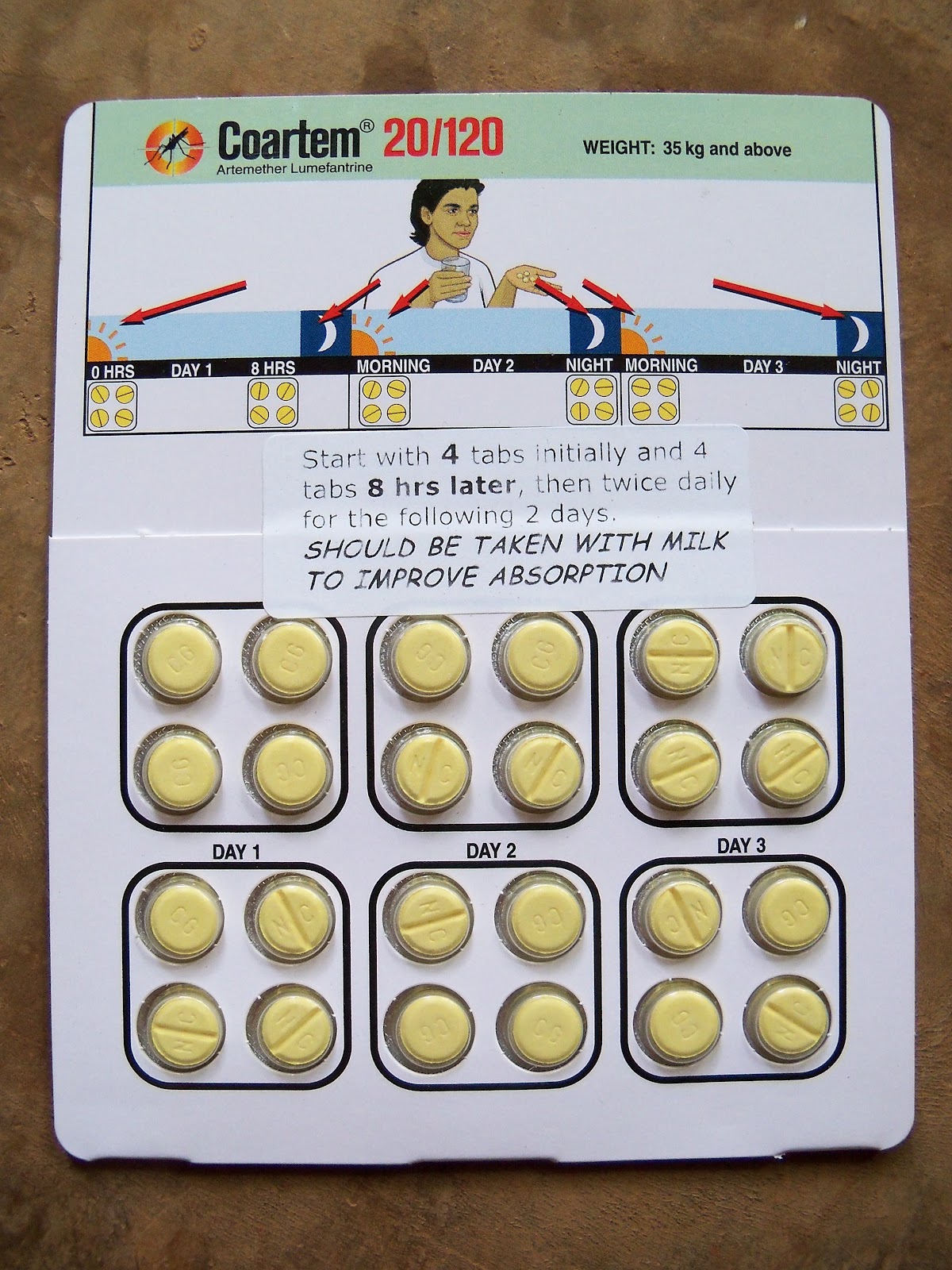
If you do get malaria there are effective, affordable treatments available, even in places with  chloroquine-resistant malaria, like Senegal. Our Health Center is usually well-stocked with government- and NGO-subsidized Malaria Rapid Tests and Coartem medication packs, especially during rainy season, when most malaria cases happen. Here are photos of the Coartem for adults that Peace Corps gave me (but which I will hopefully never need because I'm good about taking my prophylaxis) and also of a pack of Coartem for children that's available at the Health Center. 


This past Wednesday was World Malaria Day, and people all around the world did activities and held events to acknowledge the damage caused by malaria and to raise awareness of how to prevent malaria. In Salémata, my village, Wednesday was also when our Health Center has its monthly vaccination and growth monitoring activities. We didn't do anything huge because it was already a pretty busy day, but we did have an informal causerie discussion with the mothers who had brought their babies to be weighed and vaccinated and who were just hanging out, waiting for the nurse to call them up. Adama Dioulde Diallo, one of the women who does community outreach  Salémata, used  my little set of info cards to give little presentations on how to properly use and care for Long-Lasting Insecticide-Treated Nets (LLINs) and we talked about setting up a bednet care-and-repair activity sometime soon.  
Adama Dioulde Diallo

If you like maps and are interested in learning a little more about malaria, please check out the CDC's fantastic Interactive Malaria Map. It's neat. 


Thursday, April 26, 2012

Bikram Lunch

So, a lot of people in America are into yoga these days, and Bikram Yoga, where people do all that stretching and posing and whatnot in a humid room heated to 105°F (≈ 41°C), has caught on in some places. From what I understand the idea is that doing this is cleansing, that it builds endurance, that it stimulates good stuff in your body, and that it warms up and loosens your muscles. I like yoga and I like steam rooms, and it seems like a fine idea to me.

However, I was thinking about this the other day, when the temperature was about 42°C (≈108°F), while I was perched on my little stool under the mango tree, quietly sweating, waiting for Gaulo and Bailo, my host sisters, to bring over our lunch bowl (steamed rice with peanut sauce, as usual). I was thinking about the heat, and hot yoga, and what we like to call "the face-sweats" (which is happens when you eat during hot season) and how people would react if, after they finished their hot yoga workout, they were presented with a steaming bowl of rich, salty rice and sauce and told to dig in. It's funny, but not the most appetizing thought.

Pre-Lunch Face-Sweat Levels
I've made plenty of hot-season jokes about how I should have called this blog "Bikram Life" but sitting there at the bowl, spoon in hand, perspiration trickling into my eyes and dripping down my calves, "Bikram Lunch" seemed to do a better job of summing it all up.

Thursday, April 12, 2012

Hut Sweet Hut

Buckets are such a big part of my life here. I've really come to appreciate a good, sturdy bucket, especially one with a nice lid. Here's my bath bucket (with fancy sieve/soap caddy), my food storage bucket, and my gaz tank. 


My nice burner broke the other day and this little one (the only kind available in village) that doesn't have the nice pot-guard that my other had. I use my gaz to heat up water for coffee and instant oatmeal most mornings, and during cold season I'll heat up a little pot of water to add to my bathing bucket to take the edge off the chill of cold water. Some volunteers just leave their bucket out in the sun all afternoon, but because of the shady mango tree (which is great and I love) next to my hut I've had very limited success with that during the cold season. Right now it's quite hot, and I'll just leave my water buckets (which are exactly the same as my food storage and dish storage buckets) in the coolest corner of my hut and hope they don't get too warm.


This is my wooden table. It pretty much looks like this on any given morning, with my silver water filter, various mugs and water bottles, sunblock and toothpaste, and random this and that. It's a really nice table, I like it a lot. The metal water filter is nice, too, it keeps water much cooler than the dark plastic filters that some of the volunteers have.


The table has handy shelf for stacking all sorts of things, and there's a bamboo (or whatever it is, everyone in village calls it bamboo) rod for hanging clothes to dry or keeping stuff away from the rats and bugs on the ground level.


I store clothes and things in my trunks, and then I store important things in my little suitcase because it zips up, which keeps dust and critters out. The oatmeal cans also help with the bug situation, it's easy to sweep under the trunks when they're propped up, and that keeps ants from building trails along the fine cracks in the cement, and keeps the spider population in check, too.

Baby Fat Cheeks

Fatou, my host sister Mariama Kesso's baby, is adorable. People are always saying that she's "cheeks only" because her chubby little face is basically 80% cheeks. During the elections when things were really slow in village I spent a lot of time playing with Fatou while Kesso braided hair for women in the neighborhood. Last year Kesso went in to Kedougou for a week-long training on fancy braiding techniques and new styles and designs, so her hair-styling skills are very much in demand. 

Here's Fatou and I posing, Mariama Kesso, in a fancy, heavily embroidered pink outfit, trying to get Fatou to pose, me wearing the blue complet that Kesso gave me, Fatou smiling, and Fatou with her brother Mamadou, refusing to smile. 


Post-Elections

So, after a lovely vacation, some time at the office in Dakar, and a visit to Thies to meet the new group of Health Volunteers (who seem really great) during their Pre-Service Training, I'm finally back in Kedougou. It's been a busy month so I have a bit of catch-up to do, and it seems like the best place to start is with the elections, which are totally over now.

There was some unrest in parts of the bigger cities during the first campaign period, so everyone was a little nervous about how things would play out, but much to our relief the first round of elections in February went very, very smoothly. The now-former president, Abdoulaye Wade, had rigged things so that he could run for a third six-year term (which is completely unconstitutional) and many people were understandably upset by this. The first round of elections narrowed the field down to two candidates, Wade and Macky Sall, for the second runoff election in March. The BBC covered the Senegal elections, the election run-off, and the April 2nd swearing-in of President Macky Sall. It's been an interesting time for Senegal, and I'm really glad that the elections went smoothly. Guinea's troubled transition to civilian rule in 2010 and last month's coup in Mali really make me appreciate how valuable - and difficult - it can be to hang on to stability and peaceful political transitions.

Supporters of President Macky Sall