Showing posts with label Adama. Show all posts

Sunday, December 16, 2012

Shea Butter Tubs

Shea butter (kare in Pulaar and karité in French) is an extremely popular product here in Senegal. people use it as a lip balm and a body moisturizer and they also cook with it. The struck me as odd but then I tried it, on rice, and it had lovely smooth texture and a warm, nutty taste. It's much better than the soapy, waxy flavor of the bright red-orange palm oil that's also so popular around here. 

Making shea butter is astoundingly hard work. (I've been taking photos of the process and one of these days I'll get around to posting them.) The shea nuts have to be gathered, dried, shelled, pounded, ground, soaked, strained, boiled, re-strained, melted down, and poured into containers. In our area the women's groups often get together to make and sell shea butter. Usually they just pour it into old water bottles or whatever containers happen to be on hand, and a half-liter goes for around 1,000 CFA, or about $2.00 USD. (If you go to L'Occitane and buy a tub of shea butter in the U.S. it will be crazy expensive in comparison, but a reliable source tells me you can get it on Amazon for a very reasonable price.)
Mariama and the Tubs
Awhile back my host mom Mariama went to a training, funded by an NGO, that went over best practices and hygienic processing and packaging methods. They made simple but nice little labels and brought white plastic tubs in liter and half-liter sizes. Mariama bought a big stack of tubs, filled them with shea butter, and is now selling them at a slight mark-up. At some point someone from the NGO will come back and buy up all the shea butter-filled tubs and bring them to Dakar to be sold for a higher price at the markets up there.  

Mariama and Adama and the Tubs
Mariama's really proud of the little white tubs and of how professional and clean they look all stacked up and told me to go get my camera to take a picture of the ones she'd filled so far. I bought a couple, a few other PCVs said they'd like to buy a few more, and before I knew it I had a small shipment of shea tubs to haul in to the Regional House. My host mom was super pleased, we were all impressed with how nicely the shea butter was packaged, and Mankaba, Mariama's youngest son, was just happy that we had the camera out and were taking pictures of things.
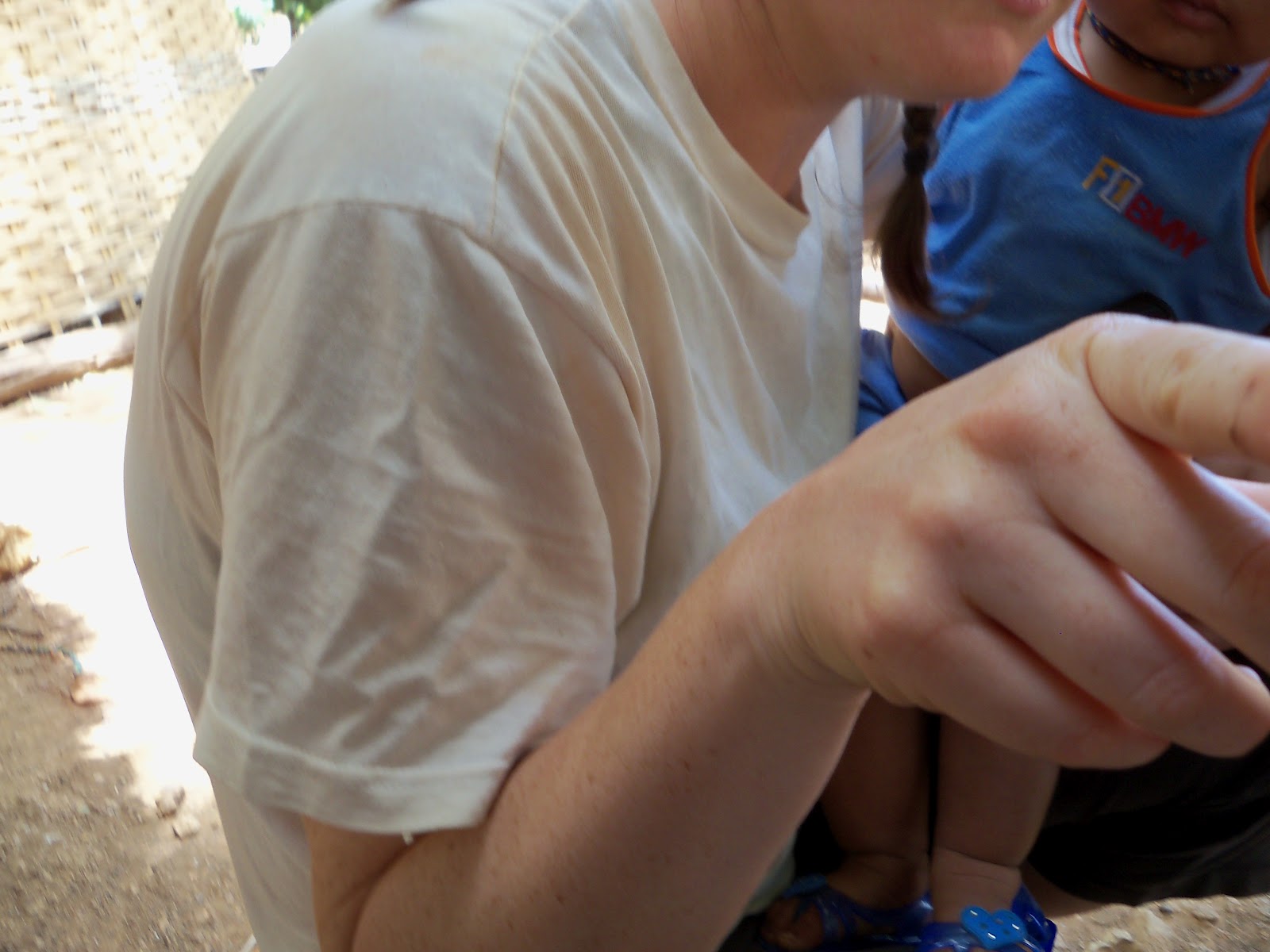
"Adama Adama Adama let me take a picture!"
(He took a bunch of photos but they pretty
much all looked like this.)

"Ok that's enough of that, Mankaba. Give it back."

I was glad to be able to show my support for Mariama (she is one of the hardest-working people I've ever met) and also happy to have a reason to stock up on shea butter, since winter (or what passes for it here) is upon us now and my lips were getting dry and chapped. Everybody wins. 

Thursday, August 30, 2012

Korité

I spent Korité, the feast day celebrating the end of Ramadan, in Salémata with my host family. I woke up, puttered around, got my complet outfit out, and waited for my host brothers to pound the big drum, signaling tat it's time for everyone who's going to the mosque to get a move on.

The drum, warming in the sun
 After mosque I walked around the compound, greeting people, being greeted, and taking photos of everyone's new clothes. My host cousin, Bineta wanted photos of both her new outfits, and we all took turns posing with my host sister's baby, little Fatou.

 Fatou's mother, Mariama Kesso, was busy all morning with food prep and cooking. We had steamed fonio (grown, processed and sold by host moms' women's group), meat, and an amazing vegetable-heavy onion sauce made with the onions, cabbage, carrots, and bitter eggplant that I brought in from town as my contribution to the family celebration.


Dinner prep under the mango tree

 After lunch, dinner prep started and the greeting continued. My host mothers Saliou Njan and Mariama wanted photos of their new outfits, and my neighbors Tatiana and Jess came by to visit and greet everyone, hold the babies and admire all the new outfits.


Adama and Fatou
 I also took a few pictures with Diabou, the stubborn, clever girl who was extremely slow to warm to me after I moved in, but who is now a great little friend. She refuses to accept having her hair braided (I can't blame her, it looks like it hurts, especially at first) so they're still shaving her head.


 After all that it was time to go greet people all around the village. I went greeting in a little group with Mariama Kesso, Fatou, and Diouma, the little girl in the blue and gold. Since the bridge to the far side of town was thoroughly washed out we picked out way along the creek bed, looking for a suitably shallow and solid place to cross.


Crossing the gulan (taro root?) field
 After a wonderful dinner of warm bread, spicy beans, flavorful yellow potatoes, and onion-y meat sauce I went to turn in at a reasonable hour and greatly relieved that the Ramadan schedule of dinner at 10:30 or 11 o'clock at night. Before I got to sleep, though, my host sister Kindi and her friend popped in to pose (sprawled out on my bed) for one last round of photos.


All in all it was a lovely holiday and it left me looking forward to the Tabaski celebration we'll have in October. 

Tuesday, July 31, 2012

Bowls

Bowls, like buckets, are a big things around here. We eat all our meals out of bowls, food is kept warm in lidded bowls, gifts and purchases of corn or soap or oil are delivered and carried in bowls. When women get married they're given bowls with lids and enamel pots in different sizes, and many women proudly display the fancier ones year-round, stacked up on shelves or tables in their sleeping huts.

Bowls are great, but everyone has pretty much the exact same ones, which can lead to confusion, especially during big events when lots of people are cooking and eating and carrying all sorts of things around in nearly identical stainless steel bowls. To keep track of things, most women like to paint their names and initials onto their bowls, usually with nail polish or whatever's on hand. Since I've been working with the other PCVs in my area on our little World Maps project my host family knew I had a bunch of little pots of paint on hand and my host aunt Hassanatou Bâ asked if I had any extra that I could use to paint her name on her bowls before she went back to Guinea for two months to visit her parents.
Hassanatou, posing for the camera. 
Hassanatou lives on our compound but I'm still not sure how exactly she's related to my host family, so I just think of her as my aunt. In any case, she is a very sweet woman; she thinks it's funny when I get things wrong, is happy to repeat herself two or three or nine times when I don't understand, and makes delicious sugary little fried dough beignets on market days. When I came back from my vacation I gave her a three-pair set of the earrings that my American family had sent with my for the women in my host family; she particularly loved the dangle-y one shaped like little golden leaves and she wears them every single day. Obviously, I was more than happy to paint her name on a few bowls.
Once I got started my host moms Saliou Dian and Mariama Souaré poked their heads into my hut to see how it was going. They liked what they saw, and asked if they could bring their bowls over, too. Pretty soon my hut was overflowing with bowls of all sizes, and with little host siblings eager to "help" with the painting. I let three of the older kids come in to do some painting and (aside from spilling paint on my floor and paint thinner on my floor mat) they were actually pretty helpful.

My hut, full of bowls. 
I made sure to use a different color for each woman's initials, for aesthetic purposes and because it makes it easy to tell them apart at a distance or in dim light. Since this bowl-name-painting-day I've been asked to do the same for the neighbors behind us and across the way, and am pretty sure that it will happen again soon. It's easy, it's fun, it hardly uses any paint, and it's nice to do something so immediately useful and delightful for people. 

Between the bowls and the map murals I'm pretty sure that there are a few people in my village who think I'm a Decorating Volunteer, sent over by the American Government to with a bucket of paint, a pack of brushes, and a mission to make things pretty.
Fancy paint for Saliou Dian, Mariama Souaré, and Hassanatou Bâ 

Sunday, July 8, 2012

Laare

Mango season is long over now, but there's been plenty of laare around for the past few weeks. Laare ("la-ray") is the Pular word for a super-sour fruit that grows on trees out in the bush. Most people like to mix it with sugar (which tastes kind of like SweetTarts candy), some mix in powdered milk (going for a CreamSicle-type thing I guess), some like to add salt (which tastes like something out of a tidepool) and little kids just eat it as is. 

I picked up a laare fruit at the weekly lumo market a couple weeks ago. It cost 25 CFA, or about 5 cents USD, and I bought a little 100 CFA sachet of sugar to go with it. 


I brought it back to my hut and cut it open. It isn't very hard to cut through; the skin is soft but the inside lining is a bit tough. At first it looks like it's a two-lobed fruit, but it's really just a bunch of pulp-covered seed packed in together.


 The part that you eat, the pulp, is slightly sweet and very tart. The longer you suck on a little seed-let (that's how I think of them, there may actually be a word for them) the more intensely our they become.


 The ridiculous sourness is why most people like to add sugar. I really don't get the salt thing, but to each their own.


 I ate some of the laare, spitting the seeds outside, and then gave the rest to few of my host brothers who were hanging out under the corossol tree near my host mom Mariama's hut. I think eating too much laare would give me a bit of a stomachache and also it's funny to watch the puckered, scrunched-up faces that the littler kids make while eating very sour things.

This reminds me of the monkey-brains
 in Indiana Jones.

Friday, July 6, 2012

Friendship and Bracelets

Awhile back Troll (one of my dear friends from Camp Unalayee) sent me a package filled with band-aids, antibiotic ointment, and other super handy things. She also sent a bag of embroidery thread and some very sharp little scissors, perfect for making friendship bracelets. After brushing up on my knot-tying skills (it's been a few years since I made any bracelets) I showed all the thread to a few of my host siblings and we got to work.

(I love all things reminiscent of Pantone color cards.)

Kindi, below left in the striped shirt and right in the red shirt, picked it up very quickly. That really wasn't a surprise, considering how good she is as braiding intricate patterns into her friends' hair, and the boys weren't far behind. They did a good job of showing each other how long to cut thread, explaining that more colors means longer pieces and more complexity, and making sure no one hogged all the bright reds, yellows, and greens, which were most people's favorites.


This pink, yellow and green bracelet on the left was my first attempt; it came out pretty well. The photo above right is me trying to get Fatou, my favorite chubby baby, to look at the camera while my three-year old host brother Mankaba took photos.

It was fun, and over the next few weeks everyone wound up with bracelets, even the little kids. It was nice to share something American that matches up so perfectly with Senegalese sensibilities - bracelets, bright colors, and friendship are all as popular here as they were at summer camp back in California.

Craft Time Under the Mango Tree


Thursday, June 14, 2012

American Gosi

Most evenings one of my host sisters or host moms will make gosi, a kind of rice porridge, to feed all the little kids (and me, sometimes) before dinner, since they often fall asleep early. I've had really bland, unappealing gosi at other people's houses, usually for breakfast, but the stuff that my host family makes is really good, almost like African rice pudding. 

The bland kind is thin and saline, made with just rice, water, and salt, and people usually eat it when they don't have enough money to add anything else. My host family is well-off enough to be able to make good, nutritious gosi, which is nice for me and great for the kids. My host sisters like to make gosi tiga, which is sweetened rice porridge with ground peanuts. The peanuts they use aren't roasted, so the flavor is mild, very unlike the roasted peanut buttery taste we're used to with American peanuts. The peanut meal thickens the porridge, giving it a rich, slightly nutty taste, as well as a big protein boost. My host family also likes to add kosam, a yogurt-ish sour milk, or a big scoop of powdered milk if they have some on hand to make it heartier and to add vitamins and protein; my host sister Mariama Kesso (whose daughter Fatou is the adorable chubby baby is so many of my photos) is fond of telling me that milk is a complete food, and that it's good for kids and mothers. 

So, my host sisters kept giving me these wonderful warm mugs of gost tiga in the evenings and I decided that I should try to make an Americanized version, something akin to rice pudding. I bought some rice, sugar, powdered milk, and brought raisins, vanilla sugar, and cinnamon in from the toubab store in Kédougou and told Kesso that I wanted help making American gosi . She thought that this was funny (watching me cook is endlessly entertaining) and everyone was curious - there are so many people on my compound (around 30 at last count) that I've never really tried to cook anything for everyone before. We boiled the water and added all the ingredients, let it simmer, and it thickened up nicely. Even though they made fun of the raisins a little (someone said they looked like "little goat poops") they liked it and ate it all. Raisins aren't available in my village and there doesn't seem to be a Pular word for them, so people kept calling them "little dates," which is pretty close. The Senegalese are known for having a big sweet-tooth and tend to really love dates, especially during Ramadan, since they're said to have been one of the Prophet's favorite foods. It went over really well, and made me want to cook more often. 


I also tried out adding a couple packets of Maple & Spice instant oatmeal to another batch of American gosi , but people were not into that. They were really polite about it, but apparently the maple flavor tasted weird and savory to them, like I'd added bullion or something. I was more than happy to keep that bowl for my breakfast, but it made me think about acquired tastes, and how strange it must be to try a new taste when you've only ever eaten from a very limited range of flavors.

Host sisters Kesso and Diabou
It was fun to cook with Kesso, and nice to share something American with my Senegalese family -- I told them that sometimes in America my mom and my grandma make rice pudding/American gosi, and they really liked that they were eating something that my family in America also eats. I think that I might get more ambitious and try making American-style spaghetti one of these days. It would be a mess to try to eat with a spoon, but since spaghetti noodle and onion sauce sandwiches are an accepted breakfast food I'm pretty sure that everyone would like it well enough. 

Friday, June 1, 2012

"Adama"

My American name is LaRocha ("la-rock-a"), but my Senegalese name is Adama. I have a number of tokorabe (people with my same name) around Salémata. I've gotten used to it, more or less, but for several months it was profoundly weird. 

It took me awhile to really identify as "Adama," and once I actually started to feel like it was my name I couldn't really get my head around how a bunch of other people also had my name. That has never happened to me before. Ever. In my entire life. It's funny, I spent a significant part of my childhood wishing that I had a name that other people had (specifically so that I could have a personalized toothbrush and name stickers) and then when I finally did it was oddly disconcerting. 

Adama and Friends
I've gotten used to it, though, and have come to appreciate some of the perks of having a normal, phonetic, immediately understood name. Greetings and mundane daily interactions are smoother and less complicated, and when people read my name off a list they don't hesitate and look around, blinking and uncomfortable, for a few seconds before attempting to say it aloud. They laugh, sometimes, amused that such an obvious foreigner would go by such a Senegalese name, but it's always friendly and often leads to questions about my family same (Souaré, "soo-are-ay") and where I live and if my family is in peace. 


Also, sometimes people are extra nice to their tokora, which is arbitrary but pleasant, and I'm not one to argue if the peanut butter lady or the bean sandwich lady wants to give me an extra spoonful just because I'm her tokora.

Baby Party

At the end of every month there is a Growth Monitoring (AKA Baby-Weighing) and Vaccination Day at the Salémata Health Center, and it is pretty much my favorite thing in village. It wasn't that way at first, though. The first few times I helped out the whole thing was so hectic (between 30 and 60 women usually show up with their children) and confusing that it really wasn't very enjoyable. I didn't understand the register system or how to fill out the Health Booklets, the babies' names all sounded like gibberish, the mix of Pulaar and French was disorienting, and there didn't seem to be an established order for who got to go first.  Over time I learned how the registers work, got to know people's names, and became comfortable enough to make start making little changes to help things run more smoothly, like carring over tables so that we weren't filling out the registers and booklets on our knees.

Overall, though, it was really heartening to see how much people in Salémata care about vaccinating their babies and making sure that their kids aren't underweight. The chaotic as they can be, Baby-Weighing Days are very well established and the Health Center staff are committed making sure they happen every month. When moderately malnourished (Yellow Zone) children do turn up (which they inevitably do) a midwife or relais consults with them, and helps provided largely by WorldVision, UNICEF, Catholic Relief Services (CRS) and the local Health Committee. If a child is severely malnourished (Red Zone) then they're admitted into the Health Center for therapeutic feeding. 

Here are the relais community health workers in charge of baby-weighing, as well as my host sister Mariama having her daughter weighed. (She was totally in the Green Zone.) 


Basically my role is to enter everything into the Health Center's registers, fill out new Health Booklets,  try to make sure things are moving along, and to smile and greet everyone. The staff has (somewhat) jokingly referred to me as the secretary on more than one occasion, which is fine by me. The Health Center already has local health workers who give shots and put toddlers on the scale and so I'm most useful when I make myself busy making things more organized and less hectic.

Here a visiting German gap-year student who stayed at the Catholic Mission for a couple months came to help out, and my friend (and same-name tokora) Adama took a photo of me holding a stack of Health Booklets.

Vaccinations Winding Down for the Day