Showing posts with label dust. Show all posts

Sunday, September 23, 2012

Falling Down huts


There are a lot of huts in various states of disrepair around. In other parts of the country you'll see mostly apartment buildings, or square brick-and-mortar huts, or round mud huts covered in a protective layer of cement. Most of the huts around me are mud, though, just mud, or maybe mud spackled with a village cement made of sand and cow dung. My little hut is just whitewashed mud, with a thin cement floor added on later in order to comply with basic Peace Corps housing requirements. It works, I enjoy it, I feel very at home in my little mud house. But the mud huts aren't permanent, and when they're no longer tenable they crumble in all sorts of interesting ways. 


This hut on the left isn't really falling apart all that much, but it has a lovely squash vine on it and I like it very much. Some of the huts, especially the bigger ones with ample surface area, have stunningly large squash vines. They remind me of frilly old-timey bathing caps or something. The one on the right has slid down quite a bit over the last few weeks, the roof just sinking lower and lower after each rainstorm.


This is my favorite falling-down hut. It was at its best last month, when the tufts of grass around the wall were still short and neon-bright and the inside space was filled with corn stalks. Now the grass on top is grown long and looks slightly dry as it starts to go to seed. The broken-down huts are ruins, but ruins from a very recent past. They're made of dirt, so watching them slowly tumble back down to the ground while the grass and trees rise up around them seems symmetrical. Back from whence they came and all that. A solid hut can last for many years, a decade or mere. It's interesting, living in a structure that isn't intended or expected to last for ages. 


All the over-lush grass spilling out of the ruins of the hut on the left reminds me of a river, crashing through floodgates, and the one on the right makes me think of a game of pick-up-sticks. They're interesting, the falling-down huts, they're quiet and weathered and caught in the midst of a drastic transition; they're a little like clouds or inkblots. They look like sandcastles, or haunted shacks, or Andy Goldsworthy installation pieces. They're neat. 

Monday, August 27, 2012

Name That Rash!!

As many people know, Peace Corps Volunteers love to describe in unsolicited detail all the positively revolting things that have gone into (and come out of) their stomachs, burrowed into their feet, or raised nasty welts across their torsos. I, alas, am no exception. 

So, a couple months ago I started getting this rash on my right knee. It wasn't particularly terrible-looking, but it was unbearably itchy, oddly hard, and started to flare up angrily in bright red swaths around both knees and across my lower back. I talked to Med, sent in some photos, applied hydrocortizone cream, and things improved. This was right when the nail of my big toe was threatening to become painfully ingrown, but after a few weeks of no closed-toed shoes (which I only wear for jogging) and soaking my foot every day my toe was fine and I went back to my normal routine, toes intact and rash-free. For a few days, anyway. 

To: Med Re: Recurrent Mild Knee-Rash
And then the rash came back with an irritating vengeance. I happened to be on my way up to the Thiès Training Center where two Peace Corps Medical Officers were kind enough to spend twenty minutes looking at my knees, running their fingers over the rashy parts, and deducing the cause of my discomfort. They immediately decided it was contact allergy, and guessed that it was caused by some sort of fabric that, combined with rainy season, my skin finds intolerable. We talked about my clothes, they asked about this and that and if I have any knee-length synthetic pants, maybe ones with seams around my knee and across my back. 

And then I realized - my running pants. My stretchy, frayed-at-the-synthetic-seams, capri-style running pants. The rash went away when I stopped jogging because of my toe. I am allergic to my pants. Problem solved. They gave me some strong anti-itch cream and, only a few days later, the rash has almost entirely disappeared. 

On a related note, while looking through my photos to find this picture I realized that I have an entire album's-worth of photos of rashes, stings, blisters, infections, and swollen lumps, taken by myself and  my fellow Kédougou PCVs and e-mailed to Med in the hopes that they can diagnose us from afar and spare us the long slog up to the Med Office in Dakar. Of course, I thought "Wouldn't it be funny if we all sent these photos in to the PC/Senegal Volunteer Newsletter? They could have a little matching-game-thing in the next issue, where people guess who was afflicted by what. Name That Rash!! Hilarious!" 

My suggestion went over pretty well with the Newsletter editorial staff; it might actually happen. 

Friday, June 1, 2012

Les Parfums de Sénégal

Not long after I came to Senegal I was in a car with a few other PCVs, and we got to talking about what scents a Senegal-themed scented candle set would include. (I think it was April's idea.) In any case, I still think about that when I catch whiffs of  Senegal-specific odors. As best I can recall, here are some of the odors we identified as being the iconic smells of PCV life in Senegal: 
  • Café Touba: at pretty much every bean sandwich lady's stand in the whole country you can buy hot, sugary little cups of Café Touba to go with your breakfast. (Many PCVs love it; I am not so much a fan.) It smells over-boiled and slightly peppery, like cloves and leaves and instant coffee.
  • Fish Market: in most markets there's a section devoted to selling all kinds of fish - big, small, fresh, dried, semi-spoiled - and it always reeks of fish guts turning rancid under the most powerful heat lamp in the world. 
  • Trash Fire: one of the least-lovely smells to wake up to. 
  • Tea Time: the singed-sugar smell that comes from cooking up the scalding, hyper-sweet ataaya tea that many Senegalese like to drink int eh afternoons (and mornings... and evenings...) 
  • Dust: it's subtle, just a light, hot, dry smell, but it's also everywhere, especially on transport. It cakes up on clothes and in sinuses and gets way down into the seams and cracks of everything, from books to keyboards to skin and hair. 
  • Mango: fresh, sweet, sun-warmed and lovely, mangoes right from the tree are one of the few silver linings to hot season. 
Other suggestions were Overpowering Body Odor (particularly while crammed in a crowded bus or a station wagon with nine other people), Sewage Puddles (a rainy season fixture in all cities), and Adji (the bullion packets that are the base flavoring for nearly all Senegalese dishes we eat on a regular basis).

Maybe the candle set would look like this. 
Sadly, for me (and the other people in the room with me right now) Trash Fire would have to be the smell that I most strongly associate with living here. While away on vacation I stepped out of the car after being picked up from the airport and the first things I thought was "Oh wow, it smells so nice here." I've heard that repeated - unprompted and almost verbatim - from several other volunteers.

There are many other smells that spring to mind when I think of my life here in Senegal, many of them quite pleasant - babies all freshly washed and lathered in warm, nutty-smelling shea butter; sweet, floral "chourie" incense paste; the fresh-baked bread smell of tapalpa village baguettes. But really, Trash Fire tends to overwhelm them all. 

Thursday, May 17, 2012

Transport

Transport is usually the worst and most unpleasant part of living in Senegal. Unless you're well-to-do and have your own car and driver the "public" transportation system is made up of a chaotic, ramshackle network of privately owned beat-up buses, rusty jumbo-vans, smaller-but-equally-rusty vans and mini-vans, pick-up trucks, horse/donkey-drawn charette carts, and safari cars. It's expensive and unpredictable (cars leave the garage as they fill up, so you wait three minutes or nine hours), the guys in charge of cutting tickets are usually loud, aggressive, and will often stretch the truth to pressure foreigners into buying tickets, and the baggage guys frequently try to extravagantly overcharge people (last time I went from Tamba the guy tried to charge 2 000 FCFA for a bag that should cost 500 FCFA) but they also tend to relent pretty quickly when you tell that that you've been here before and you know the price.

A typical transport receipt 
Each city has a "garage," which is just a big parking lot where cars and buses park and wait for passengers. The garages in Dakar and the other big cities are sprawling and hectic, filled with vendors and ladies selling ceeb u jen, but the mayhem is somewhat organized. There are garage managers, and the guys in charge of selling tickets who make sure that cars get passengers and leave in the proper order. In the smaller cities, like Kédougou the garages are smaller, slower-paced, and more manageable. In a mid-sized village like Salémata the "garage" is just a bench in front of a sandwich shack, with a guy who sits around, making tea and writing out little ticket stubs. (I happen to glue all my travel tickets, baggage stubs and other paper miscellany into my journal, so at this point I have a comprehensive catalog of the kinds of hand-written receipts that there are in Senegal.

We don't get many nice transport cars out in Salémata on account of our road being rough, dusty, unpaved, somewhat washed out in a few places, and 80 kilometers (about 50 miles) long. It gets worse once the rainy season starts; the road gets muddy, occasionally floods completely by the bigger bridges, and we don't get very many cars at all.

A sept-place and a green van in the Salémata Garage
The nicest vehicle in the Salemata Garage that morning

I got lucky with this car because it had decent-looking tires, the engine sounded ok, the uplostery was still pretty much intact, and it had been painted pretty recently. The interior (below on the left) looked pretty nice. The photo below in the right is of the Salémata garage and main street, where the weekly lumo market happens on Tuesdays. There weren't many people around this morning (which is partly why I felt comfortable taking photos), just people stopping on to buy bread and boutique owners sweeping garbage into little piles and lighting little trash fires. 


I only had to wait for about an hour and a half, which really isn't too bad. The car also didn't stop that many times to pick people up along the way, so it never filled up to the point of being ridiculously over-capacity. They also let me hop out right in front of the Peace Corps house (conveniently right on the road in from Salémata) and that made things easier, too.

Saturday, April 28, 2012

New Roof!

My host family, the Souarés, are wonderful. At the beginning of each month I give my host father and mothers a modest cash contribution, to cover the cost of feeding me, sheltering me, just generally taking care of me. At the beginning it was awkwardly difficult to get him to take it, there was a lot of "No, you are part of the family now, we can't accept that!" but I would insist. By now we've fallen into a more comfortable oh-you-don't-have-to-but-thank-you-oh-no-thank-you sort of arrangement, and I've never had any problems with my contribution being squandered, (there are PCVs who have had problems) I'm confident that it goes toward food and basic supplies. 

When I gave my monthly contribution right before I left for vacation it got awkward again, with my host father insisting that I shouldn't be giving money for food that I wasn't going to be around to eat, but I said that it Peace Corps gave it to me to give to them (which is pretty much how it works) and so he considered that and then said "Ok, well, we'll repair your hut's roof while you're gone, so it will be very ready for rainy season." I said that sounded just fine, and when I got back to village I had this lovely, still-golden, water-tight, relatively spider-free thatch roof, and I was totally, totally happy about it. 
Fixed up for move-in day  - May 2011
Older, weathered thatch - Feb 2012

FANCY NEW THATCH! - Apr 2012

Thursday, April 12, 2012

Hut Sweet Hut

Buckets are such a big part of my life here. I've really come to appreciate a good, sturdy bucket, especially one with a nice lid. Here's my bath bucket (with fancy sieve/soap caddy), my food storage bucket, and my gaz tank. 


My nice burner broke the other day and this little one (the only kind available in village) that doesn't have the nice pot-guard that my other had. I use my gaz to heat up water for coffee and instant oatmeal most mornings, and during cold season I'll heat up a little pot of water to add to my bathing bucket to take the edge off the chill of cold water. Some volunteers just leave their bucket out in the sun all afternoon, but because of the shady mango tree (which is great and I love) next to my hut I've had very limited success with that during the cold season. Right now it's quite hot, and I'll just leave my water buckets (which are exactly the same as my food storage and dish storage buckets) in the coolest corner of my hut and hope they don't get too warm.


This is my wooden table. It pretty much looks like this on any given morning, with my silver water filter, various mugs and water bottles, sunblock and toothpaste, and random this and that. It's a really nice table, I like it a lot. The metal water filter is nice, too, it keeps water much cooler than the dark plastic filters that some of the volunteers have.


The table has handy shelf for stacking all sorts of things, and there's a bamboo (or whatever it is, everyone in village calls it bamboo) rod for hanging clothes to dry or keeping stuff away from the rats and bugs on the ground level.


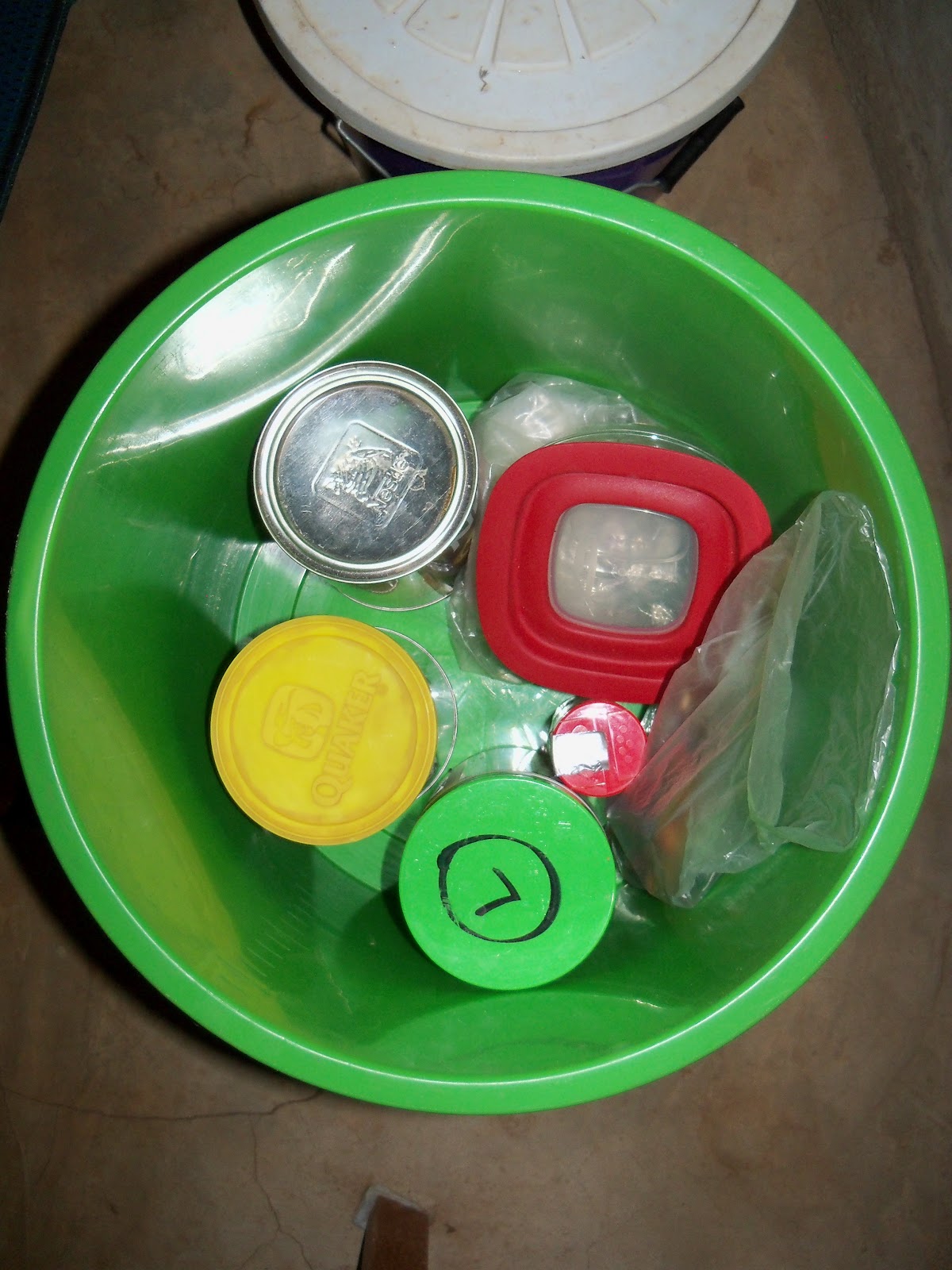
I store clothes and things in my trunks, and then I store important things in my little suitcase because it zips up, which keeps dust and critters out. The oatmeal cans also help with the bug situation, it's easy to sweep under the trunks when they're propped up, and that keeps ants from building trails along the fine cracks in the cement, and keeps the spider population in check, too.

Saturday, February 11, 2012

Peace Corps Cars


So, I had step throat, which was unpleasant but at least it didn't last very long. It started when my throat was all scratchy on lumo (market) day, but I just walked around the ladies selling bananas and pretty fabric and cheap jewelry and fried bon bon donut-type things, sucking on frozen sachets of bissap (kind of like hibiscus) juice and blaming the dust. By the next morning it was clear that I had strep so I called Peace Corps's Med Office and after a little back and forth and a lot of box-reading (Salémata has no actual pharmacy and apparently I am not allowed to take the AMOX 500 amoxicillin from the Health Center because it's made by some company in India with suspect dosage reliability) I took some of the antibiotics that I had in my med kit and went back to bed. It was weird and sad to realize that the health services that I'm always encouraging people to use are considered unusable by our medical office. It's also reassuring that I have my own med kit and that there's an office full of people in Dakar worried about my antibiotics. 

The AMOX 500 that I wasn't allowed
to take looked like this.
The next day I'd been planning on meeting up with Jubal and Jackie, a couple of my PC neighbors, and biking in to Kédougou (biking is fun, and also there was a nation-wide transport strike) but I really just didn't feel up to it. Luckily Pape (one of the Peace Corps support staff guys) was coming out to my area to do some site set-up prep work in a village called Dakately, and he was nice enough to drive over and pick me and Jubal up. Getting a ride in a Peace Corps car is wonderful, so much smoother and faster and less dusty than public transport or biking, I was really happy about it. 

We rode along to check out Dakately (lovely village, worst road ever) and were impressed by their lovely community gardens, enthusiastic people, fancy new health post buildings, and spectacular cell phone reseau (reception). Really, though, there are sections of the road that seem more like a boulder field crossed with a ravine and one part is very obviously going to just be a river during wet season. But aside from that it's delightful. 

Tuesday, January 10, 2012

Salémata/Ethiolo Bike Ride


Ethiolo, where my wonderful neighbor Tatiana lives, is about 5 or 7 kilometers away from Salémata. 


I don’t know how far it is exactly, but it doesn’t take very long to bike, even including the two hills that are too steep to bike up.


Things That Make Me Nervous

Now that the rainy season is long over and even the cold season is beginning to peter out and heat up, people are doing a lot of grass-clearing. These are photos from the lot next to the Regional House, and even though the fire was under control it made a snapping, crackling sound that kept me on edge until it went out. 


Some of it seems to be prescribed burning, and some of it is just to clear fields, and either way it creates lots of smoke. Sometimes it’s really hazy around town. 

Tuesday, November 29, 2011

Home Away From Home

When I walk from my hut to get water (or go to the boutique, or buy a bean sandwich) I usually walk through this field, next to the Sofidetex shed where they store cotton-related stuff, and, especially with the palm tree, the view always strikes me as being very Northern California-esque, like the foothills around Mount Hamilton. 


Friday, November 4, 2011

Village/Other People's Blogs

It's been a busy week or so, and now I''m headed back to village for a few days.

I'll be back next week to help welcome the new Agriculture PCVs when they arrive for Installs, but in the meantime if you want to read more I've added more links to my list of blogs written by PCVs in Senegal. 

Friday, October 28, 2011

Revenge of the John Boehner Laterite Road Tan

So, last week when we got on the Niokolo bus from Kédougou to Dakar, a very nice man sitting in the row behind us handed over these disposable surgical masks and told us to put them on. We weren't totally sure we would need them (the bus had windows and everything) but dutifully put them on anyway. (Left to right: me, Leah, Marielle, and New Ian.)


Four hours later when we stopped in Tamba we were very glad we'd done so.


Eight hours after that we were in Dakar, enjoying croissants and fancy coffees and attracting all sorts of sidelong looks from the well-kempt people on their way to work. (Once the Peace Corps office was open for business we went and took showers and felt much more presentable.) 

Monday, October 24, 2011

Gold & BBC News

The BBC recently posted a slideshow about gold mining in Senegal, relatively close to where I live. There's also a BBC video on gold mining in the region of Kedougou as well as a BBC report on prostitution in mining areas. This isn't my village, but if you're interested it does give you a good idea of what my region looks like - I feel awkward walking around taking videos of people going about their daily business; it makes me feel like a tourist, and I don't want my neighbors to start snapping cellphone pics of the toubab washing clothes in a bucket or carrying water or whatever else I'm doing.

At this very moment what I'm doing is being in Dakar, thinking about taking a pool-side nap at the Club Atlantique. A few of up came up on the overnight Niokolo bus last night, and it was uneventful (aside from the ridiculous amounts of dust) but still quite tiring, so I'm going to try to catch up on a little sleep before heading over to the Thies Training Center for the Health & Environmental Education Summit that starts tomorrow.  

Friday, September 16, 2011

Biking en brousse

Since the start of the rainy season I've expanded my list of things that I consider "bike-able" to include rock fields, sand pits, and small rivers. The only thing around here that it turns out you really can't bike through is mud. Your wheels sink in, and the mud cakes up so thick on the brakes that the wheels stop turning. Even pushing a bike through the deep clay mud in some places requires stopping every few minutes to scrape off the rims and tires. 

A few days ago I biked from Dindéfélo to Kédougou, all by myself. I'd done it before, but in a group and from the other direction, so I was a little nervous about remembering where the turnoffs were, and about mud and water level, but it went just fine. It is en brousse, but even out in the sticks there are little villages and huts along the way, and at the one fork where I wasn't sure which was to go I just asked an old man who was sitting under a tree, enjoying his morning tea, and he told me which way would take me toward Kédougou.

My favorite part is this stick bridge, supported by tall big branches and wires attached to another tree off to the left. I felt very Indiana Jones-ish starting my day off with a 30 kilometer (19-ish mile) ride through the African countryside. Except that I had a water bottle and a helmet instead of a whip and a fedora. 

Stick Bridge!


Monday, September 5, 2011

Dindefelo

I'm off to help out with a youth camp in Dindefelo, a village about 50 kilometers away from the city of Kedougou. I'll be back to town and internet access in a couple weeks! 

Saturday, September 3, 2011

Return of The John Boehner Laterite Road Tan

Salémata is about 80 kilometers down a red dirt road from Kédougou; in a Peace Corps Land Rover it takes about two hours, but in a mini-bus or a truck it can take a lot longer than that. Ever since rainy season started up in earnest it's been even more of a trek than usual, and on bad days it's completely flooded in several places. My neighbor Sully and I waited until it had been sunny long enough for things to dry out a bit, and decided to head in to town.   As you can see, even with the recent rains tamping things down it's a pretty dusty ride... 


The best part (other than the icy icy cold Coke that I bought as soon as we arrived) was that when we got back to the Kédougou Regional House the water was on (it's not on a lot of the time) so that I got to take a shower not out of a bucket, which was lovely. 

Friday, September 2, 2011

Incommunicado!

So, everything's been pretty good lately, except for the recent lack of internet access and our road being flooded on and off for most of the last week or so.

I'm back in town for a few days and am using a little USB InternetEverywhere key to connect to the cell phone network and get online. 

I'm going to slog through my Gmail for awhile and then will get to uploading some photos and posting some updates. 

Monday, May 16, 2011

Arrival in Kédougou!

Now that PST is over the six of us who are moving to to Kédougou had to drive down in sept-places ("seven-seats") station wagons, which are creepily hearse-like. There were three of us in each car, and aside from the dust and the heat it was about as pleasant as a 12-hour drive through sub-Saharan Africa can be.

That is me in the back seat, Patrick in the front seat, Marielle taking the picture, and all of our bags and boxes and water filters and mosquito nets and med kits and bikes and helmets and everything piled on top. Here's the map of the trip - I'm in the city of Kédougou now, and on Thursday I'll be installing in Salémata.
The current volunteers (PCVs) made a fantastic dinner, and the next day we got up and went to see part of one of the Bassari initiation ceremonies. I have photos, of that and of our swearing-in ceremony in Dakar, and I will post those soon too.