Showing posts with label PCPP. Show all posts

Wednesday, March 20, 2013

Latrines: A Very Good Thing

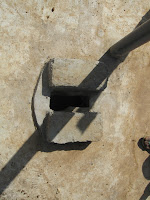
During my baseline survey, many of the 62 family compounds I interviewed talked about wanting a latrine. There were some pre-existing latrines in the area, but many of them weren't very sturdy and were susceptible to collapse, particularly during the rainy season.
A partially collapsed latrine
Two years ago the Catholic Mission of Salémata held a training for a group of village masons that covered ideal pit dimensions, durable latrine designs, how to mold a concrete latrine cap, and installing ventilation pipes. So, there was obviously a high level of community interest and available skilled masons, but the high cost and inconvenience of obtaining building materials meant that very few families had actually installed a latrine, and of course, without latrines people are forced to practice outdoor defecation, which contributes to the spread of dysentery and other diarrheal diseases.


All of this led me to write a Peace Corps Partnership Project grant proposal, and with an incredible amount of support from my friends and family in America it was quickly funded. Once I had the means, it was time to go back to the hardware stores in Kédougou where I’d gotten quotes, order the materials and arrange to have them transported the 80k (50 Miles) on a rough, unpaved road out to Salémata. Ordering the supplies was painless, but withdrawing the money from my account turned out to take almost five hours of waiting at the bank. With help from my host family and neighbors we spread the word about the project requirements and held meetings to make a list of participants and a plan for how people would pay their contributions, compensate the masons, and verify that the work had been done. Once all the supplies actually arrived (there were some truck problems and some inadequate stock problems, so it took a couple tries to get everything delivered and ready to go) participants paid their contribution and got checked off on the Chief’s list, and then came in pairs to collect their cement and materials.

Once the latrine building got underway I walked around with the head of the village Sanitation Committee to check in and see how things were going. We chatted with people about the project, talked about different ways to make covers for the hole, and made sure to work the many benefits of hand-washing with soap into the conversation. People were really positive and it was a huge relief to see that the whole thing had worked – latrines were built, awareness was raised, progress was made.
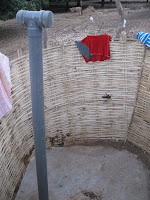
Some of the latrines are totally done and in use, but there are a few people who still need to put up the crintin privacy fencing. Now that hot season is upon us the Bassari craftsmen are starting to show up to the weekly lumo market with sheets of crintin, stools, beds, tables and chairs made from something that everyone calls bamboo, so hopefully the rest of the latrines will be screen in and operational in the next few weeks.


Working on this project has been a fantastic experience. As one of my neighbors said, “Adama, this is a very good thing for Salémata. Your work is good and now we have a latrine in our household. It will be a good thing and the people will see the latrines and remember you. Whenever I look at our latrine I will think of you.” As flattering as that is, this project wouldn't have happened (or would have been much, much more difficult) if people hadn't already been interested in latrines, if there hadn't been trained masons on hand, if my family and friends in America hadn't put on such a successful fundraiser, or if the chief and Sanitation Committee hadn't be willing to do the lion’s share of the accounting and explaining and distribution of supplies, and I’m grateful to everyone who contributed time, energy, and support to the project.


Monday, October 22, 2012

Privy Party!

Back in August my amazing grandmother (with lots of support from my equally amazing mother and family) decided to celebrate her birthday by hosting a lovely tea party to benefit the latrine-building project I’d proposed. She called it a Privy Party and it was a resounding success. She raised so much money that I was able to expand the project, increasing the number of latrines that we’ll be able to build.
I can only hope that the latrines
will turn out as well as the tea party did ~ 

My community here is very excited about this project, and I’m eager to start building, but there are still a few weeks left until the rainy season is definitively over and building can begin. I’ll be doing my best to make the most of this time to increase awareness of the importance of latrines and of how to go about getting involved with the project - each participating family will provide a contribution, learn about disease prevention and latrine use and maintenance, and assist with the construction of their latrine. It’s not a hard sell; people around here are generally really enthusiastic about latrine use. Some compounds already have latrines, but they’re often used by a large number of people, leading to the latrine prematurely filling up and breaking down.  Many other houses have no latrine at all, and so people resort to practicing outdoor defecation (a fancy way to say pooping off in the bushes or out in the fields) or settle for using a neighbor’s latrine when they can, which is fine but tends to exacerbate the overuse problem.

I really can’t do enough to thank all the people who contributed to this project – especially my family – but I will do my best to post updates as the project progresses and to (eventually!) send out thank-you cards. It’s been really moving to see how engaged and motivated people are to help other people improve their communities.

Thursday, August 16, 2012

Latrines!

Diarrhea is no fun. Many things can contribute to high levels of diarrheal diseases, including improper hand-washing (i.e., without soap) and a lack of access to latrines. Along with malaria and respiratory infections, diarrhea is one of the most common reasons that people living my community have to seek treatment at the Health Center; during my baseline survey people frequently talked about how not having a latrine on the compound was a problem for their family. Many people in my village understand the connection between good sanitation and illness prevention, but almost half of the people living around me don't have access to a toilet or a latrine. (This really makes the personal pit-latrine that I have all to myself, right behind my hut, seem positively luxurious.) People usually don't have latrines because of the cost of the cement and rebar needed for the latrine cap, because the only place to buy cement and rebar is nearly 85 kilometers (about 50 miles) away on a fairly terrible dirt road, or because they don't know how to go about installing one. 

Not having enough latrines contributes to open-air defecation, or, less delicately, pooping behind a bush. This means that it's really easy for fecal matter to spread around under the trees where kids play and into the fields where their parents farm, bringing with it any amobeas and dysentery (which will forever remind me of Oregon Trail) and giardia germs that might have been lurking about.

My little host sisters and cousin, playing under a tree. 
In order to address this problem I started planning a latrine project at the end of last year but after my first funding source fell through things were delayed, and by the time I decided to apply for Peace Corps Partnership Project (PCPP)  funds the rainy season was fast approaching. I'm hoping to get the PCPP fully funded by the time the rains stop so that we can start building in November, when the weather is dry and the corn harvest has been brought in.
Image courtesy of
practicalaction.org

This little illustration basically shows what we'll be building if all goes as planned. After I arrange for the purchase and transport of the materials out to our village, each family, with the help of local masons, will reinforce the pit and lay in a cement cap, creating a sturdy, long-lasting latrine for the whole compound to use. 

The village chief, local health workers, and the heads of local women's groups will hold community meetings before and during the implementation phase to explain the cash and in-kind contributions that will be required for participation the project. We'll also have educational sessions about proper latrine usage, latrine maintenance, using oral rehydration solution to treat diarrhea, and the importance of hand-washing with soap.

This PCPP is intended to facilitate the construction of 30 latrines, and if they're all installed successfully then pretty much every compound in my area will have a proper, functional latrine and know how and why to use it,  which will be absolutely fantastic.  If it goes well this project will serve as a model for future latrine projects in neighboring communities, which would also be fantastic.    

If you would like to read the project profile (or if you're interested in donating to this project) please take a look at the PCPP profile page.