Showing posts with label babies. Show all posts

Wednesday, April 17, 2013

Cute Overload

So, maybe you thought that just because I'm single and childless I wouldn't be churning out look-at-this-baby posts, but I'm here today to tell you about Fatou. Fatou is adorable. That is just a fact. She’s chubby and boisterous and as gregarious as a person can be without being able to actually talk yet. Now that she’s old enough to not forget me every time I leave for a few days, she likes to come over stand in the doorway of my hut, waving "bye-bye" and chattering away in baby Pulaar.

A few weeks ago, at the Tuesday lumo market, her grandmother bought her a new complet outfit and her mom, Mariama Kesso, bathed her, dressed her, doused her in baby powder, and brought her by for an impromptu photo shoot before she had a chance to get it all dirty.


Look how cute this baby is. Cute and smart and sassy. She's got the adorability trifecta going on. I cannot even handle it.

Wednesday, March 20, 2013

Fatoumata Bineta Souare

While I was away in Thiès and Saraya last month, my youngest host mom, Kade, had her third baby. I knew she was pregnant but hadn't realized that she was that far along, and was disappointed that I missed the baptism. Of course, I still brought some baby gifts over to her hut - a soft blanket, some fancy soap, a pretty new shirt, and a baby outfit in a little purple bag – and she told me that she’d wanted to name the baby after my mother in America, but when she was visiting everyone just called her “Neene Adama,” literally “Adama’s mom,” and so no one was completely sure how to pronounce or write her actual name, so they named the baby Fatoumata Bineta instead. Maybe next time, though, if she has another daughter.


(Father Sadat and big sister Diabou; new baby girl Fatoumata Bineta; mother Kade)

Friday, February 1, 2013

Snacktime for the Kiddos

The kids on our compound are really adorable. Much more so than most kids. They do have their disgusting moments - the runny noses, the peeing on my lap, the grubby little hands trying to shove gnawed-on biscuits into my mouth - but they're funny and affectionate and they listen when I tell them that I'm busy and they have to go play somewhere else. They're also healthy. My host dad once worked as a community health worker and one of my host sisters is training to be a matrone, which is a kind of birth attendant/women's health worker, and I think that helps. It also helps that he's the traditional village chief and the family has enough corn and rice to go around.

Some people in our area have some pretty unsettling ideas about maternal health, such as the all-too-common misconception that pregnant women shouldn't eat too many vegetables and fruits because vitamins will make the baby fat and cause a difficult birth. Very few women go to all four of the recommended pre-natal visits and many don't make it to any at all. Thankfully, while she was pregnant my host sister made a point of going to all her appointments, of drinking lots of milk, and of eating as well as is possible in our area. She practiced exclusive breastfeeding during those early months  (which is particularly important in areas with unreliably potable drinking water), made really nutritious weaning/supplementation porridges, and ensured that Fatou, her daughter, got all her vaccinations on time. And it shows. It really, really shows. 
Afternoon snack for Fatou and Sajou
Fatou just turned one, she's walking (and dancing, in her wobbly little way), and is quite a bit taller and bigger than a lot of two-year-olds in town. People are always saying that she's "all cheeks" because she has such a chubby little baby face, which is exactly how toddlers are supposed to look. In an area where it's not uncommon to see little kids with the brittle, orange-tinged hair that signals chronic malnutrition, she has dark, thick hair that's already long enough to braid. As a Health PCV I could do a thousand talks about proper nutrition and healthy weaning foods and the importance of vaccinations and still not make as convincing of a case for improved nutrition and preventative care and Fatou and her chubby cheeks do simply by existing.

Thursday, August 30, 2012

Korité

I spent Korité, the feast day celebrating the end of Ramadan, in Salémata with my host family. I woke up, puttered around, got my complet outfit out, and waited for my host brothers to pound the big drum, signaling tat it's time for everyone who's going to the mosque to get a move on.

The drum, warming in the sun
 After mosque I walked around the compound, greeting people, being greeted, and taking photos of everyone's new clothes. My host cousin, Bineta wanted photos of both her new outfits, and we all took turns posing with my host sister's baby, little Fatou.


 Fatou's mother, Mariama Kesso, was busy all morning with food prep and cooking. We had steamed fonio (grown, processed and sold by host moms' women's group), meat, and an amazing vegetable-heavy onion sauce made with the onions, cabbage, carrots, and bitter eggplant that I brought in from town as my contribution to the family celebration.


Dinner prep under the mango tree

 After lunch, dinner prep started and the greeting continued. My host mothers Saliou Njan and Mariama wanted photos of their new outfits, and my neighbors Tatiana and Jess came by to visit and greet everyone, hold the babies and admire all the new outfits.


Adama and Fatou
 I also took a few pictures with Diabou, the stubborn, clever girl who was extremely slow to warm to me after I moved in, but who is now a great little friend. She refuses to accept having her hair braided (I can't blame her, it looks like it hurts, especially at first) so they're still shaving her head.


 After all that it was time to go greet people all around the village. I went greeting in a little group with Mariama Kesso, Fatou, and Diouma, the little girl in the blue and gold. Since the bridge to the far side of town was thoroughly washed out we picked out way along the creek bed, looking for a suitably shallow and solid place to cross.


Crossing the gulan (taro root?) field
 After a wonderful dinner of warm bread, spicy beans, flavorful yellow potatoes, and onion-y meat sauce I went to turn in at a reasonable hour and greatly relieved that the Ramadan schedule of dinner at 10:30 or 11 o'clock at night. Before I got to sleep, though, my host sister Kindi and her friend popped in to pose (sprawled out on my bed) for one last round of photos.


All in all it was a lovely holiday and it left me looking forward to the Tabaski celebration we'll have in October. 

Friday, July 6, 2012

Friendship and Bracelets

Awhile back Troll (one of my dear friends from Camp Unalayee) sent me a package filled with band-aids, antibiotic ointment, and other super handy things. She also sent a bag of embroidery thread and some very sharp little scissors, perfect for making friendship bracelets. After brushing up on my knot-tying skills (it's been a few years since I made any bracelets) I showed all the thread to a few of my host siblings and we got to work.

(I love all things reminiscent of Pantone color cards.)

Kindi, below left in the striped shirt and right in the red shirt, picked it up very quickly. That really wasn't a surprise, considering how good she is as braiding intricate patterns into her friends' hair, and the boys weren't far behind. They did a good job of showing each other how long to cut thread, explaining that more colors means longer pieces and more complexity, and making sure no one hogged all the bright reds, yellows, and greens, which were most people's favorites.


This pink, yellow and green bracelet on the left was my first attempt; it came out pretty well. The photo above right is me trying to get Fatou, my favorite chubby baby, to look at the camera while my three-year old host brother Mankaba took photos.

It was fun, and over the next few weeks everyone wound up with bracelets, even the little kids. It was nice to share something American that matches up so perfectly with Senegalese sensibilities - bracelets, bright colors, and friendship are all as popular here as they were at summer camp back in California.

Craft Time Under the Mango Tree


Thursday, June 14, 2012

American Gosi

Most evenings one of my host sisters or host moms will make gosi, a kind of rice porridge, to feed all the little kids (and me, sometimes) before dinner, since they often fall asleep early. I've had really bland, unappealing gosi at other people's houses, usually for breakfast, but the stuff that my host family makes is really good, almost like African rice pudding. 

The bland kind is thin and saline, made with just rice, water, and salt, and people usually eat it when they don't have enough money to add anything else. My host family is well-off enough to be able to make good, nutritious gosi, which is nice for me and great for the kids. My host sisters like to make gosi tiga, which is sweetened rice porridge with ground peanuts. The peanuts they use aren't roasted, so the flavor is mild, very unlike the roasted peanut buttery taste we're used to with American peanuts. The peanut meal thickens the porridge, giving it a rich, slightly nutty taste, as well as a big protein boost. My host family also likes to add kosam, a yogurt-ish sour milk, or a big scoop of powdered milk if they have some on hand to make it heartier and to add vitamins and protein; my host sister Mariama Kesso (whose daughter Fatou is the adorable chubby baby is so many of my photos) is fond of telling me that milk is a complete food, and that it's good for kids and mothers. 

So, my host sisters kept giving me these wonderful warm mugs of gost tiga in the evenings and I decided that I should try to make an Americanized version, something akin to rice pudding. I bought some rice, sugar, powdered milk, and brought raisins, vanilla sugar, and cinnamon in from the toubab store in Kédougou and told Kesso that I wanted help making American gosi . She thought that this was funny (watching me cook is endlessly entertaining) and everyone was curious - there are so many people on my compound (around 30 at last count) that I've never really tried to cook anything for everyone before. We boiled the water and added all the ingredients, let it simmer, and it thickened up nicely. Even though they made fun of the raisins a little (someone said they looked like "little goat poops") they liked it and ate it all. Raisins aren't available in my village and there doesn't seem to be a Pular word for them, so people kept calling them "little dates," which is pretty close. The Senegalese are known for having a big sweet-tooth and tend to really love dates, especially during Ramadan, since they're said to have been one of the Prophet's favorite foods. It went over really well, and made me want to cook more often. 


I also tried out adding a couple packets of Maple & Spice instant oatmeal to another batch of American gosi , but people were not into that. They were really polite about it, but apparently the maple flavor tasted weird and savory to them, like I'd added bullion or something. I was more than happy to keep that bowl for my breakfast, but it made me think about acquired tastes, and how strange it must be to try a new taste when you've only ever eaten from a very limited range of flavors.

Host sisters Kesso and Diabou
It was fun to cook with Kesso, and nice to share something American with my Senegalese family -- I told them that sometimes in America my mom and my grandma make rice pudding/American gosi, and they really liked that they were eating something that my family in America also eats. I think that I might get more ambitious and try making American-style spaghetti one of these days. It would be a mess to try to eat with a spoon, but since spaghetti noodle and onion sauce sandwiches are an accepted breakfast food I'm pretty sure that everyone would like it well enough. 

Sunday, June 3, 2012

South by Southeast by Southwest

From St Louis I headed down to the Peer Support Network (PSN) meeting in Thiès, at the Training Center. Peace Corps/Senegal’s PSN is still relatively new, so we went over by-laws, brushed up on listening skills with  mock phone calls, and discussed issues that have come up over the last few months. We also spent sessions discussing how to best handle PCVs who are dealing with domestic violence problems in their communities and host families and how to talking with Volunteers considering early termination (ET). It was a good meeting (even though my stomach was completely off the whole time) and I liked learning more about Peace Corps resources and hearing ideas from other PCVs on how to talk about and cope with stressors and difficult situations that crop up throughout a Volunteer’s service.
Senegal's PSN 2012
After the PSN meeting it was back to Dakar to catch transport back to Kédougou. I stopped by the office, where Hadiel helped me set up Twitter via SMS (it’s more complicated in Senegal than in America), and I visited Rachel, Emily and their adorable new son Xavier.

I ate my fill of buttery pastries from the decadent Grain d’Or bakery, packed up my backpack, and headed back down to Kédougou, where I am now. I’m just sitting around, typing and waiting for the rain to let up so that I can go run errands, get packed up, and turn the internet back on so that I can post this. When it starts raining we run around the house unplugging everything important because when lightning strikes on or near our Regional House compound everything plugged in just gets completely fried. We lost several routers that way last rainy season (I hear that’s down from six the year before) when no one was around to unplug things in time.

24°C = 72.2°F and 40°C = 104°F
In any case, soon I’ll bike over to the market to pick up a seriche gift for my family (a couple kilos of carrots and dry beans), buy my transport ticket to get back to Salémata tomorrow, gaze wistfully at the closed post office (I have a package waiting but the Poste has very limited hours and I won’t be able to get it before I go back to village) and stop by the office supply boutique to buy a notebook.

I’ll be back in Kédougou in a couple weeks, but now that I’ve figured out the whole SMS-tweeting thing you can look forward to those, for as long as my phone credit lasts, anyway. 

Friday, June 1, 2012

Baby Party

At the end of every month there is a Growth Monitoring (AKA Baby-Weighing) and Vaccination Day at the Salémata Health Center, and it is pretty much my favorite thing in village. It wasn't that way at first, though. The first few times I helped out the whole thing was so hectic (between 30 and 60 women usually show up with their children) and confusing that it really wasn't very enjoyable. I didn't understand the register system or how to fill out the Health Booklets, the babies' names all sounded like gibberish, the mix of Pulaar and French was disorienting, and there didn't seem to be an established order for who got to go first.  Over time I learned how the registers work, got to know people's names, and became comfortable enough to make start making little changes to help things run more smoothly, like carring over tables so that we weren't filling out the registers and booklets on our knees.

Overall, though, it was really heartening to see how much people in Salémata care about vaccinating their babies and making sure that their kids aren't underweight. The chaotic as they can be, Baby-Weighing Days are very well established and the Health Center staff are committed making sure they happen every month. When moderately malnourished (Yellow Zone) children do turn up (which they inevitably do) a midwife or relais consults with them, and helps provided largely by WorldVision, UNICEF, Catholic Relief Services (CRS) and the local Health Committee. If a child is severely malnourished (Red Zone) then they're admitted into the Health Center for therapeutic feeding. 

Here are the relais community health workers in charge of baby-weighing, as well as my host sister Mariama having her daughter weighed. (She was totally in the Green Zone.) 


Basically my role is to enter everything into the Health Center's registers, fill out new Health Booklets,  try to make sure things are moving along, and to smile and greet everyone. The staff has (somewhat) jokingly referred to me as the secretary on more than one occasion, which is fine by me. The Health Center already has local health workers who give shots and put toddlers on the scale and so I'm most useful when I make myself busy making things more organized and less hectic.

Here a visiting German gap-year student who stayed at the Catholic Mission for a couple months came to help out, and my friend (and same-name tokora) Adama took a photo of me holding a stack of Health Booklets.

Vaccinations Winding Down for the Day


Friday, April 27, 2012

World Malaria Day

So. Malaria. Basically, a person gets malaria from the bite of a mosquito infected with Plasmodium parasites. The parasites get into the bloodstream, mess up the red blood cells, and start making the person all feverish and then really, really sick. If another uninfected mosquito bites that sick person then that mosquito becomes infected and can pass on  Plasmodium parasites to the next person it bites. 
Image thanks to iayork.com
Only female Anopheles mosquitoes can infect humans with the Plasmodium parasites that cause malaria. (Italics because it's the Latin name,not because I'm trying to be extra emphatic.) There are different strains of Plasmodium parasites, some more dangerous than others, and here in Senegal we have mostly Plasmodium falciparum, which is pretty much the worst kind. You can avoid getting malaria by taking prophylactic medications like doxycycline, mephloquine (Lariam), or atovaquone (Malarone). If, for whatever reason, these medications aren't an option you can reduce your chances of getting malaria by using insect repellent, sleeping under a bed net, and getting rid of standing water and other mosquito breeding grounds. 

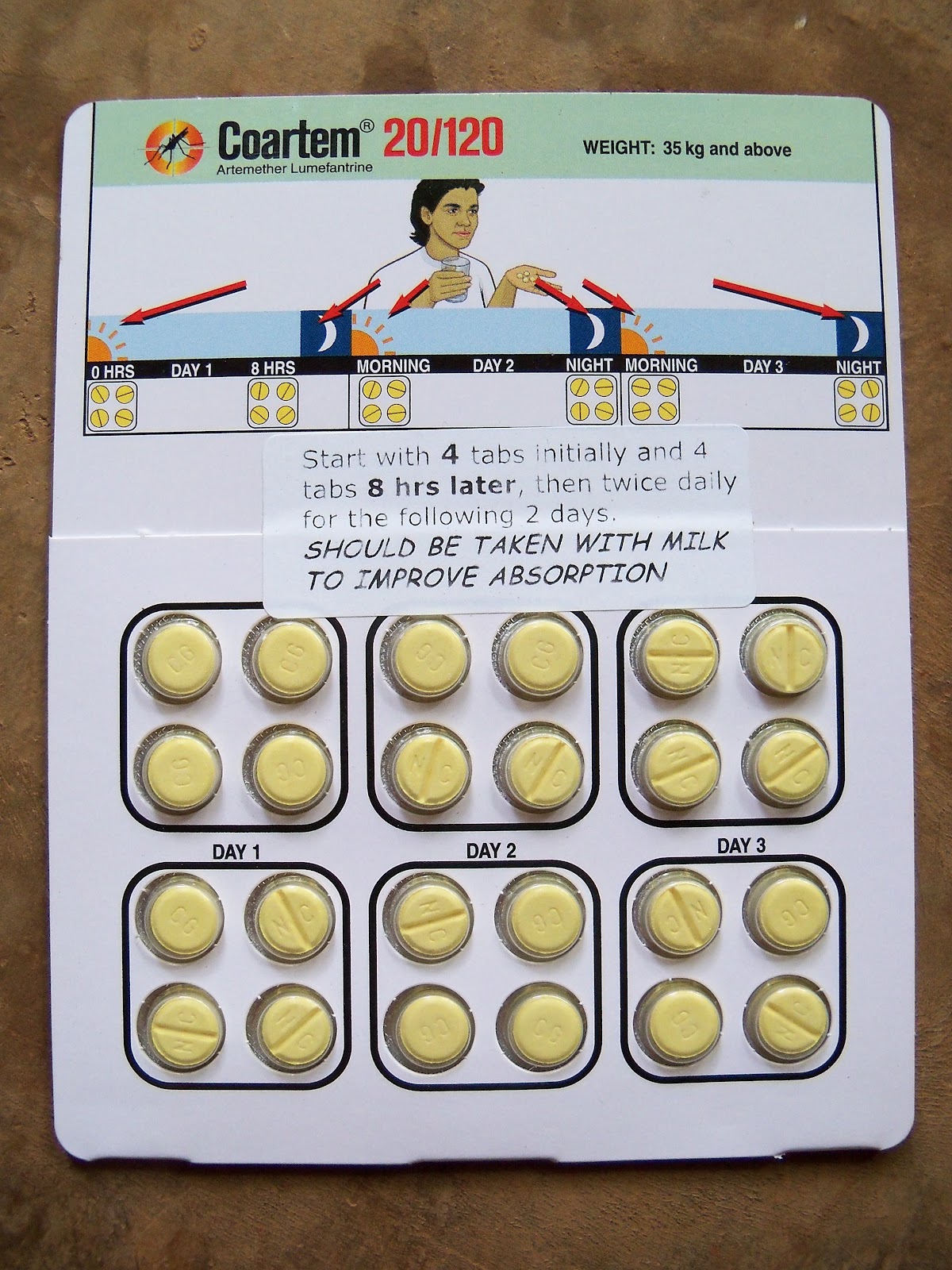
If you do get malaria there are effective, affordable treatments available, even in places with  chloroquine-resistant malaria, like Senegal. Our Health Center is usually well-stocked with government- and NGO-subsidized Malaria Rapid Tests and Coartem medication packs, especially during rainy season, when most malaria cases happen. Here are photos of the Coartem for adults that Peace Corps gave me (but which I will hopefully never need because I'm good about taking my prophylaxis) and also of a pack of Coartem for children that's available at the Health Center. 


This past Wednesday was World Malaria Day, and people all around the world did activities and held events to acknowledge the damage caused by malaria and to raise awareness of how to prevent malaria. In Salémata, my village, Wednesday was also when our Health Center has its monthly vaccination and growth monitoring activities. We didn't do anything huge because it was already a pretty busy day, but we did have an informal causerie discussion with the mothers who had brought their babies to be weighed and vaccinated and who were just hanging out, waiting for the nurse to call them up. Adama Dioulde Diallo, one of the women who does community outreach  Salémata, used  my little set of info cards to give little presentations on how to properly use and care for Long-Lasting Insecticide-Treated Nets (LLINs) and we talked about setting up a bednet care-and-repair activity sometime soon.  
Adama Dioulde Diallo

If you like maps and are interested in learning a little more about malaria, please check out the CDC's fantastic Interactive Malaria Map. It's neat.