Showing posts with label mangoes. Show all posts

Wednesday, March 20, 2013

First Mango of the Season

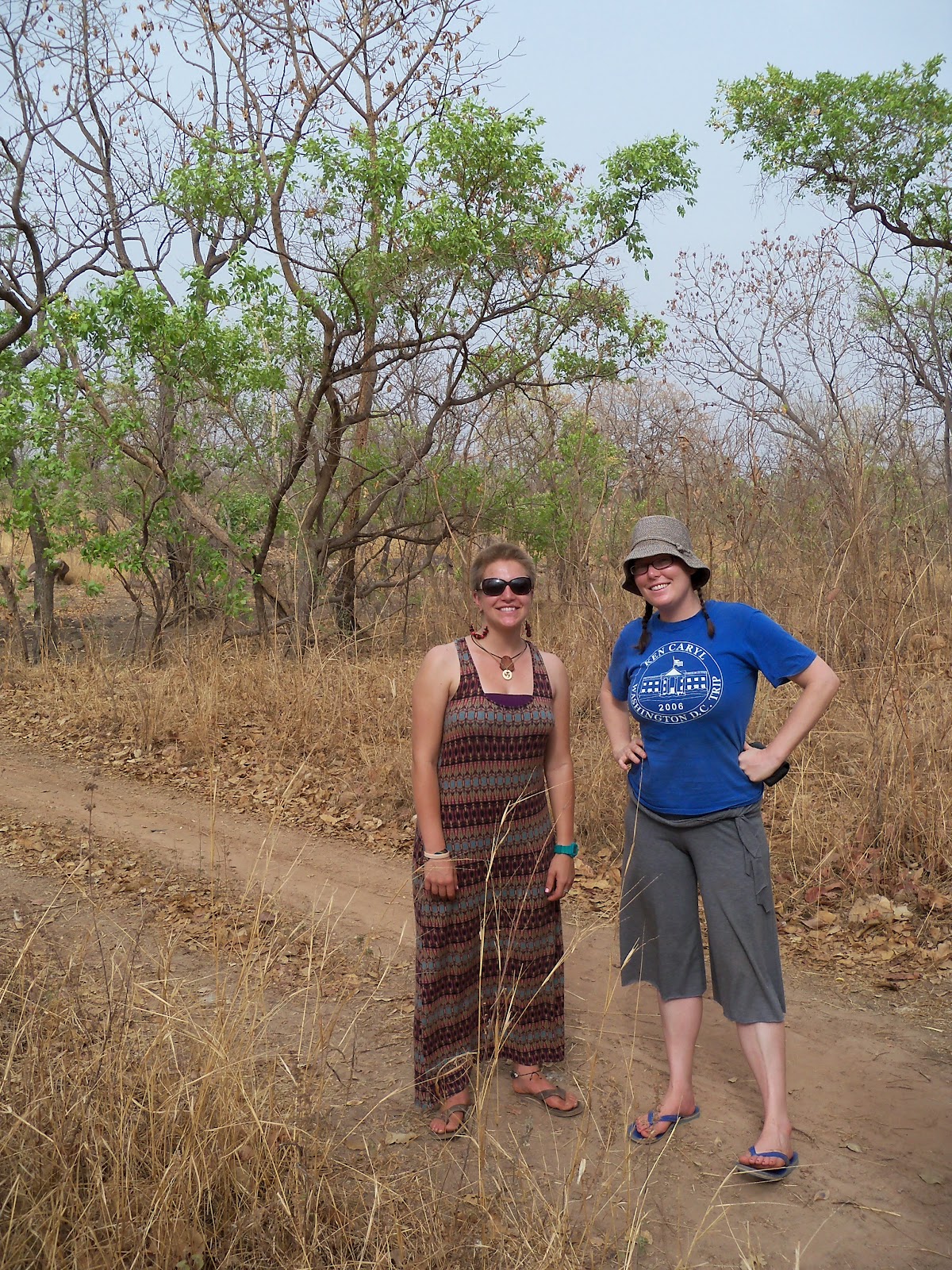
The mangoes in Salémata aren’t quite ripe yet, but last week Katie O. and I walked over to the Bassari village of Ethiolo, where the mangoes have been ripe for a few weeks now. We went to greet our friend Tatiana’s old host family and to buy some souvenirs – the Bassari craftsmen make fantastic masks and figurines. Over the years the Bassari have been mostly converted to Catholicism, but they’ve retained a lot of their traditional animist culture and hold initiation ceremonies every spring.


On the way back Katie’s shoe broke, and she did what any Senegalese kid would do in that situation: root around for a bit of plastic bag, MacGyver it back together, and keep on walking.


Thursday, May 17, 2012

Demystification & Installation

During Pre-Service Training (PST) the Peace Corps Trainees (PCTs) get to go on a Volunteer Visit (VV) to see the villages where they'll be living and serving for two years. Every region (and even every site) is very different, and it's really good to get a basic idea of what it's like there. Is there a water spigot or will you be hauling water from a well across town? Are there mango trees or just thorn bushes? Does the village have a baker and boutiques or nothing at all in the way of places to buy snacks? The PCT gets to sort of shadow a current Peace Corps Volunteer (PCV) for a few days, and hopefully that helps demystify the whole life-in-village thing a little bit.

I took PCT Katie O. out to her village, and it went really, really well. She'll be the first volunteer ever to serve in her village, and people seemed genuinely excited and really, really, really nice. They fed us wonderful food, (fonio! chicken and sauce!) showed us around town, and were just generally really hospitable. There's a baker, some boutiques, a bean sandwich lady, lovely community gardens, a couple good hand-pump forages for water, and her hut and latrine were mostly finished.

Katie (the PCT) and myself
Getting ready to bike the rest of the way in 
Yesterday, accompanied by Mamadou Diaw (basically the boss for Health PCVs in Senegal), we went back to install Katie in her village. The traditional village chief gave a welcome speech; the head nurse from the Health Post gave a welcome speech; Mamadou gave a speech about Peace Corps, likening a PCV to a knife, which cannot cut by itself, urging the community to be patient with language, and thanking them for their overwhelming hospitality. Her hut and latrine were all ready to go, her family had built her a little fenced in garden, and the entire community had prepared a huge arrival party in her honor. Dioula ("joo-la"), her sister and village namesake, had had matching complet outfits made, they gave her earrings and a necklace, the school children had prepared a song-and-dance in her honor, and the griot musicians and the older women all sang and danced -- it was an amazing party, above and beyond what most villages put together, and it was completely heartwarming. 
Katie (the PCV!) and her tokora
I tried to stay in the background, taking photos and greeting as many people as possible, playing the photographer and mostly taking pictures with her camera. After the first round of singing and dancing there was a parade through the village, which was funny because there was next to no one to to see the parade, since everyone was in the parade, but it was fun. 

Parade through the village of Dakateli
After all that the party continued, but they pulled us aside to feed us lunch. We were presented with the biggest bowl of rice I've ever seen, and a small vat of rich, wonderful sauce with two entire chickens chopped up in it. It was all very reassuring -- when a community invests this much time, effort, energy in making the PCV feel welcome, included, and well cared for it bodes well for everyone. Not that it isn't exhausting and overwhelming or that village life won't be incredibly challenging in many ways, but it's a very good start.

Dancing and singing for the new arrival


Wednesday, March 7, 2012

Special Occasions

There haven't been many big holidays lately, but in January there was the Grand Magal, when many members of the Mouride brotherhood make a pilgrimage to the conservative religious city of Touba to commemorate the exile of Cheikh Ahmadou Bamba, who was persecuted for his piety. Magal isn't really a big thing down in the south of Senegal, where there aren't many Mourides and people tend to be less conservative, but I still heard people talking about it from time to time. (For example, I wear pants pretty much every day in Kédougou, but up in Touba women are not allowed to wear pants in public.)

The last holiday that we celebrated in Salémata was Gamou, the Birth of the Prophet Muhammad. It's Mawlid in Arabic, I think Gamou is from Wolof, but that's what everyone seemed to be calling it in French and Pulaar, too. 

I've heard that some people make a pilgrimage to Tivaouane for Gamou, but in Salémata they rented a big tent and we just had a big get-together around the mosque. People came out of the woodwork (and over from Guinea) to hang out in the mango grove and cook rice with meat in giant, cauldron-like marmite pots. This was just before the first round of elections, while there were still a lot of very angry protests happening in Dakar and some of the other big cities, and my host father explained that everyone would be praying for peace, which I thought was good. 


Some members of my extended host family came down from Dakar, for Gamou and to get away from the election strife, and Mariama Kesso got a chance to show off how chubby and adorable her daughter Fatou has gotten. Everyone wanted a photo with Fatou, and she got tired of being posed with after a bit, but it was still cute.


The Red Cross Youth Group did a lot of cooking and carrying huge bowls of rice and meat around to different groups of people; Daouda "Petit" Ba came late and got a bowl all to himself; Sadat Souaré (my host father, in white with the red scarf) walked around, greeting everyone and explaining things to me.


The Youth of Salemata
 The younger kids spent most of the day playing around, the same way they usually do when they don't have school. My little host brother Mankaba (on the right) and his friends had some sort of imaginary kitchen going on. I think.


Me and the Host Fam


Tuesday, June 21, 2011

I Love Panoramas.

This is the view of the main cooking/eating/lounging area of the Souaré compound. My hut is off to the right. I spend a lot of time sitting around under this mango tree, smiling at people and trying to keep up with conversations. (Which is still really hard, and pretty tiring mentally, so I also tend to spend a lot of time zoning out and watching the chickens and goats running around getting into things.) For the first week or so I would sit around here with my host moms and drink the super-sweet tea that is so popular in Senegal, but I started to worry about my teeth melting from so much exposure to what is basically hot sugar syrup (also it kinda gives me a stomachache most of the time) so now I just sit around, shelling peanuts and pointing at the goats and saying goats! and so on.


Below is the closest well to my house. I am not so great at sloshing the bucket around to get it to fill up in an efficient way (also I don't have my own bucket on a rope and don't like having to go around asking to borrow one even though no one would mind at all) so I walk to the forage pump on other side of the field, at the elementary school, and pump my water there.

I generally pump one or two 15-liter buckets of water every day in village. I use a bucket with a lid, and I fill it up, strap it to the back of my bike, and ride/walk it back across the field and up the little hill to my hut. Even though most women (and many children) pull and haul a lot more water than that, a lot farther than that, and without the assistance of a bike, everyone clucks and says I am très brave to be fetching water all by myself.


Monday, June 6, 2011

Life in the Village

So. I have been living in Salémata for almost three weeks now, and things are going pretty well. I have one host father, three host mothers, and an entire fleet of host siblings, cousins, and I'm-not-sure-if-I-really-understand-how-we're-related-but-sure-yea-thanks-type relations. My host family is nice, and other than the to-be-expected awkwardness of moving in with a family of strangers, there haven't been any real problems. They've already hosted one volunteer, so they know about Peace Corps, and generally what to expect. However, specifics are sometimes tricky. For instance, the two oldest teenage girls expected to eat their meals with me. Just me. In my hut. While all of the other women and children ate together in the courtyard area. Which felt profoundly weird. I felt a little bit bad explaining that while I knew they meant well, I just didn't want to do that. They were mildly confused as to why I wouldn't want to eat in the comfort of my own room, but respected my wishes nonetheless.

I'm currently in my Observation Period, so I'm not supposed to be starting any big projects or anything like that yet. I'm supposed to use this time to get to know my way around, start to integrate into the community, and get a sense of how things work in the village. I've been working on my Pulaar language, getting furniture and things for my hut, reading under the mango tree during the heat of the day, fetching water, helping women shell peanuts in the courtyard, riding my bike around, and doing some prep work for my Baseline Survey. I also bought some house paint and color tints, and over the next few weeks I'm thinking of doing some small painting projects, maybe a World Map Mural at the nearby elementary school.

The staff at the Salémata Health Center (recently upgraded from being just a Health Post) seems really great and I've spent a few mornings just chillin' in the Health Center waiting room, introducing myself over and over again and feeling really weird about being invited to sit in on people's medical consultations. (It did turn out to be quite informative, though.) I also came for the monthly Vaccination Day and got to sit at a little table, helping the pharmacist fill out the vaccination ledger, and for a "causerie" meeting, where people from the Health Center and local NGOs got together with one of the local women's groups to talk about

I've posted some photos of my hut, and when I come back to town in a few weeks I'm planning on posting an album of my host family and some of the things I do around the village. And, of course, the castle.

Lessons Learned

In no particular order, here are a few of the things I have learned so far:

1. I've been told that the giant, scorpion-looking spider things (which are attracted to light and come skittering in around my feet when I turn on my headlamp at night) are harmless, but the caterpillar-ish centipede things (which I have not seen yet) have a nasty, poisonous bite.

2. My neighbor Sully was right about the Salémata Health Center having fantastic food. Last week (when I came to observe a 10:00am sanitation presentation that didn't wind up starting until 2:30pm) they invited me to have lunch with them and they served delicious rice and fish and vegetables.

3. You really can't buy vegetables in Salémata. Aside from a few sad little tomatoes and onions that sometimes show up at the weekly lumo market, you have to go 80 km (50 miles) to buy them at the market in Kédougou. Or plant a garden yourself.

4. Pulaar grammar and vocabulary is all sorts of fun. Jangugol means "to read," "to study," and "to learn." So no one really has any idea when I'm being a serious student and when I'm relaxing with a good book. Which and be both good and bad. Also, Pullo Fuuta has 24 classes of articles, meaning that there are 24 ways to say "the." It gets even better when you throw "these" and "that" and "this" into the mix...

5. I have come to think of 'cold' as a flavor. As Cady knows, it it currently my favorite flavor. Along with 'Snickers.' (I was not a huge fan of Snickers before, but I have recently realized that they are fantastic. And also almost entirely unavailable outside Dakar.)

4. My host brother was right about how much easier it is to fetch water by strapping the covered bucket on the back of my bike than it is to carry it on my head.

5. It was maybe not the best idea to read As I Lay Dying straight through in one ungodly hot afternoon. It put me in a strange mood and set me up for a series of extra-strange social interactions.

6. According to some people, my life here sounds just like Little House on the Prairie, except with a hut, and in the hills, and in Africa, and with texting. (I never actually read Little House on the Prairie, so I will have to take their word for it.)

7. Infinite Jest is long.1

8. I am really lucky to live in a village (almost more of a town, really) that has a bean sandwich lady. And extra-extra lucky that the beans are pretty tasty.

9. I can be needlessly difficult and contrarian at times. Particularly when I am hot and/or hungry. (This isn't so much something I have learned so much as been made more vividly aware of over the last few weeks...)

10. If everything goes well it takes three hours (squished in between a girl with two live chickens and a man holding a very small baby) in a van-type vehicle for me to get from Salémata to Kédougou. Yesterday everything went well, alhamdoulilaye.

________

1. In Senegalese culture it's really incredibly offensive to eat things in front of others without sharing (but serious nose-picking is ok) and people will not decline to eat half your Clif bar, bean sandwich, etc, if given the opportunity. If people have something they want to eat then they do it in their rooms or in some other non-public space, and so I frequently do the same, holing up in my hut to eat a secret apple or packet of Biskrem,a especially since lunch is often not until 2:00pm. Also, I don't yet feel comfortable openly using my laptop or iPod in village, so I only listen to music and podcasts at night and at naptime, and pretty much hide in my room whenever I have laptop-based work to do. Given all this daily pseudo-secrecy, combined with the fact that I have an assumed Senegalese name (Adama Hawa Souaré) and often pretend to be married or engaged, Infinite Jest is maybe not the worst book to be reading at this particular time in my life.

________               
                   
a. Biskrem is an extremely tasty chocolate-creme filled cookie, produced by Ülker (a Turkish brand owned by the Yıldız Holding group) and wildly popular in Senegal, West Africa. 
b. Apologies for all this footnote business to everyone except for the three of you who I am mostly sure will find it amusing.

Tuesday, May 17, 2011

Install Prep & How Hot It Is Today

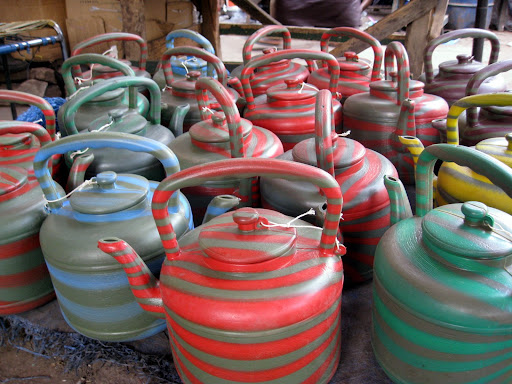
Today I'm going to go into the market to finish buying things for installation at my site. Peace Corps gives us an installation allowance, and yesterday I bought a foam mattress, a couple trunks, some odds and ends, and a variety of buckets, tubs, cups, spoons, and kettles.
These are the type of kettles we bought for our latrines. I'm pretty sure toilet paper will not be available for purchase in our villages, so most people are going to be switching over to "the water method," which is what Senegalese people do. (People use water and their left hand to clean themselves off in the toilet, which is why it's really, really not okay to eat, greet, or do pretty much anything with your left hand here.) Most people also have a few of these kettle floating around for handwashing, teeth brushing, ablutions before prayers, and so on. Handy!

So. I could go one and write all about cultural insights and all the ways my life will change while living in Salémata, but really I just want to talk about how hot it is right now.
It's 8:30 in the morning at and it's already getting pretty warm. When there's a little wind it's much better, but yesterday afternoon the breeze died and the humidity went up to 112% (I checked on Wunderground) and coming back from the market was kind of like swimming through hot pudding.

The silver lining is that because it is so hot during the afternoon no one does anything except dozing in the shade, drinking water by the liter and eating mangoes. Could be worse.